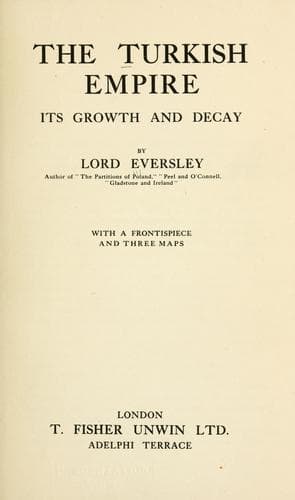
The Turkish Empire, Its Growth and DecayEversley, G. Shaw-Lefevre (George Shaw-Lefevre), Baron
History
The Turkish Empire, Its Growth and Decay
Eversley, G. Shaw-Lefevre (George Shaw-Lefevre), Baron
Turkey -- History
The Mussulman States of North Africa, at the commencement of Solyman’s
reign, were in the hands of degenerate and incompetent Mahommedan
rulers, who exercised little control over the Arabs of the hinterland.
The cities on the coast were the haunts of pirates, who sometimes
sailed under the flags of these States, but more often under no flag
but their own. They preyed on the commerce of the Mediterranean,
bringing their prizes into their ports and selling the captives as
slaves, with the result that in Tunis alone there were twenty thousand
Christian captives. These corsairs formed squadrons of ten or twenty
galleys, under the command of admirals, chosen from the most daring and
adventurous of them. They were called corsairs, but, in fact, they were
mere pirates, knowing no law but their own, and that founded on robbery
and murder. The sea-dogs in command of these pirates gained great
experience in handling their ships and squadrons. They ravaged the
coasts of Spain, Italy, and France, and even occasionally of England
and Ireland, devastating the cities and villages and carrying away
booty and captives.
It has been shown that Selim paid great attention to his navy, and
increased his ships in number and size. Solyman followed the same
course. But his admirals and captains did not compare in skill and
daring with those of the pirate squadrons. When Solyman became aware of
this, he most astutely invited the ablest and most experienced of these
pirates to take service under the Ottoman flag, and to bring with them
their ships and men. He gave high appointments to them, raised them
to the rank of admirals and commanders-in-chief of his navy, over the
heads of the officers of his regular service.
Public-domain text, read in full here on John Shaqi.
Reviews
Reviews
No reviews yet
Be the first to share your thoughts on this work.
Elsewhere in the archive
Join the Discussion
Join the discussion
Sign in to leave a comment or review.
Sign InorCreate an account