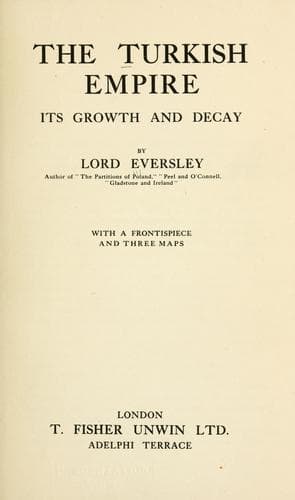
The Turkish Empire, Its Growth and DecayEversley, G. Shaw-Lefevre (George Shaw-Lefevre), Baron
History
The Turkish Empire, Its Growth and Decay
Eversley, G. Shaw-Lefevre (George Shaw-Lefevre), Baron
Turkey -- History
Meanwhile the Christian Powers had been greatly alarmed by the loss of
Cyprus and the atrocities above described. At the instance mainly of
the Pope, an alliance was formed in 1570 with Spain and Venice, with
the object of opposing the growing strength of the Ottomans in the
Mediterranean. A great fleet was fitted out by these Powers, and was
placed under the command of Don John of Austria, the natural son of the
late Emperor, Charles V, a young man of only twenty-four years, who had
shown his capacity in the measures for the expulsion of the Moors from
Spain, and was already reckoned one of the best generals of the time.
The fleet consisted of two hundred galleys and six powerful galleasses
with heavy armaments. It was manned by eighty thousand soldiers and
rowers, one-half of whom were provided by Spain and one-third by
Venice, the remainder, one-sixth, by the Pope. Don John was in supreme
command. The Spanish division was commanded by the Prince of Parma,
soon to become notorious in the Netherlands under Philip II, and who
was later in command of the Armada fitted out in Spain for the invasion
of England.
The fleet assembled at Messina on September 21, 1571, too late for the
relief of Cyprus. The Turks collected in the Gulf of Lepanto a much
greater fleet of two hundred and ninety galleys manned by a hundred and
twenty thousand soldiers and rowers. But they had no large galleasses
with powerful armaments to compare with those of the Spaniards. The
fleet was commanded by the Capitan Pasha Ali, a young man without
experience in naval war. The second in command was Ouloudj. Perted
Pasha was in command of the troops. He and Ouloudj were opposed to
an immediate battle with the allied fleet on the ground that their
men were not as yet sufficiently trained. At a council of war heated
discussion took place. The Capitan Pasha insisted on immediate attack.
Ouloudj broke off the discussion, saying, “Silence. I am ready, because
it is written that the youth of a Capitan Pasha has more weight than my
forty-three years of fighting. But the Berbers have made sport of you,
Pasha! Remember this when the peril draws near.”
The rowers of both fleets were galley slaves chained to the oars. On
the Turkish fleet they were Christians who had been made captives in
war. On the Christian fleet they were the sweepings of the jails. In
both cases the admirals promised liberty to them if they performed
their duty in the coming battle.
Public-domain text, read in full here on John Shaqi.
Reviews
Reviews
No reviews yet
Be the first to share your thoughts on this work.
Elsewhere in the archive
Join the Discussion
Join the discussion
Sign in to leave a comment or review.
Sign InorCreate an account