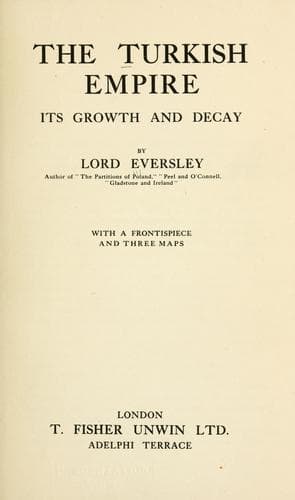
The Turkish Empire, Its Growth and DecayEversley, G. Shaw-Lefevre (George Shaw-Lefevre), Baron
History
The Turkish Empire, Its Growth and Decay
Eversley, G. Shaw-Lefevre (George Shaw-Lefevre), Baron
Turkey -- History
There can be no doubt that at the beginning of the seventeenth century,
when Sir Thomas Roe wrote these dispatches, the Ottoman Empire was in
a condition of unparalleled disorganization, and its various races
were in a state of untold misery, owing in part to the want of strong
men at its head, and in greater part to the system of corruption which
had infected every branch of its administration. If at this time any
neighbouring Power had been in a position to attack it, the Empire
would not have been able to offer resistance. But Spain, after the
reign of Philip II, was almost as decadent as Turkey. Germany was
distracted by internal religious wars and was unable to concentrate on
external foes, while Russia had not as yet developed a position which
made her formidable to the Turks.
It has already been stated that there was a break in the disastrous
rule of the harem when Murad IV came of age and was able to take the
reins of government from the hands of his mother. The Sultana Validé
was a very clever woman, with excellent intentions, and practically
ruled the State during his minority. But she was not equal to the task
of coping with the grave difficulties of the time. The Empire was
going to the bad in all directions. The Persians, taking advantage
of the confusion in Turkey, declared war and successfully invaded
the provinces of Erivan and Bagdad. The two Barbary provinces of
Algiers and Tunis were asserting independence. They engaged in
piratical attacks on the commerce of the allies of the Porte, and were
negotiating separate treaties with them. The internal condition of
the Empire became worse than ever. There were frequent outbreaks of
Janissaries, who imposed their will on the Sultana.
Public-domain text, read in full here on John Shaqi.
Reviews
Reviews
No reviews yet
Be the first to share your thoughts on this work.
Elsewhere in the archive
Join the Discussion
Join the discussion
Sign in to leave a comment or review.
Sign InorCreate an account