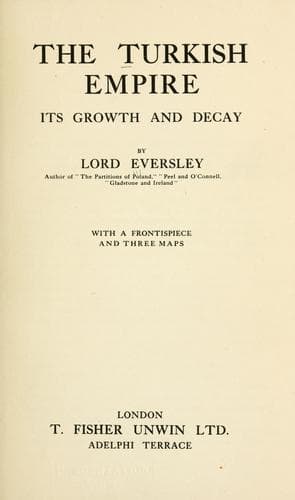
The Turkish Empire, Its Growth and DecayEversley, G. Shaw-Lefevre (George Shaw-Lefevre), Baron
History
The Turkish Empire, Its Growth and Decay
Eversley, G. Shaw-Lefevre (George Shaw-Lefevre), Baron
Turkey -- History
While the Porte was thus engaged in the endeavour to add to its domain
at the expense of the Republic of Venice, it was incurring a very
serious shrinkage of Empire in the Mediterranean, along the northern
coast of Africa. Historians agree in assigning to the middle of the
seventeenth century the virtual severance from Ottoman rule of the
two Barbary States of Algiers and Tunis. It is not possible to fix a
precise date in either case, for the process of amputation was slow and
was spread over some years, and long after the Sultan had practically
ceased to exercise any real power over these dependencies the semblance
and form of suzerainty was maintained. The main cause for the loss of
these provinces was the practice which had grown up, under the corrupt
administration of the Porte, of selling the posts of governors of
them to the highest bidders in money. In place of men of energy and
of capacity, able to control the unruly elements of mutinous soldiers
and disaffected Moors and Arabs, governors were appointed under a
system of purchase who were quite incapable of performing the duties
of their office, and who merely thought of filling their pockets and
recouping themselves for their outlay. The practice then arose for the
Janissaries and other Ottoman soldiers forming the garrisons of Algiers
and Tunis to elect their own chiefs. The appointments of these men,
Deys, as they were called, were for a time submitted to the Sultan for
approval or veto, but later this form was discontinued, and the Deys
elected by the soldiery became the real dominant authorities in these
States, and eventually superseded in form, as well as in substance, the
feeble pashas sent nominally as governors from Constantinople. Virtual
independence was thus achieved. Both States provided themselves with
fleets of powerful war vessels, which roamed over the Mediterranean and
the Atlantic as far as the coasts of Ireland and Madeira, preying upon
the commerce of all countries, irrespective of whether they were at war
with the Porte or not. They were, in fact, pirates. The captured crews
were employed as slaves in the bagnios of Algiers and Tunis. The best
evidence of the actual, though not yet of the formal, independence of
these Barbary States was that other Powers sent their fleets to attack
and bombard them, and to destroy, if possible, their pirate craft,
without declaring war against the suzerain power, the Porte. Thus, as
early as 1617 a French fleet, under Admiral Beaulieu, made an attack on
the Algerian fleet of forty vessels of from two hundred to four hundred
tons, and destroyed many of them. In 1620 a British fleet, under Sir
Richard Mansel, in retaliation for the capture of no less than four
hundred British merchant ships in the previous five years, made a
similar attack on Algiers, without, however, much result. In 1655,
another British fleet, commanded by Admiral Blake, under orders from
Protector Cromwell, bombarded Tunis, and destroyed a great part of its
Public-domain text, read in full here on John Shaqi.
Reviews
Reviews
No reviews yet
Be the first to share your thoughts on this work.
Elsewhere in the archive
Join the Discussion
Join the discussion
Sign in to leave a comment or review.
Sign InorCreate an account