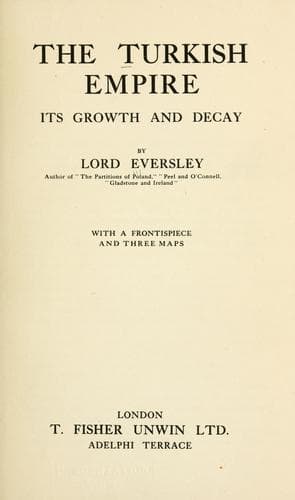
The Turkish Empire, Its Growth and DecayEversley, G. Shaw-Lefevre (George Shaw-Lefevre), Baron
History
The Turkish Empire, Its Growth and Decay
Eversley, G. Shaw-Lefevre (George Shaw-Lefevre), Baron
Turkey -- History
In the course of 1669 the prospect of a successful defence of the
city was increased by the arrival of a French fleet, commanded by
the Duc de Noailles, and having on board the flower of the French
nobility and six thousand soldiers. They were joined later by auxiliary
squadrons of the Pope and the Knights of Malta. The combined fleet,
consisting of seventy vessels, bombarded the Ottomans from the sea,
while the besieged opened fire on their front. The allies hoped to
place the Turks between two fires and to draw them from the trenches
which invested the city by land. The attack, however, failed owing
to the accidental blowing up of some of the attacking vessels. This
brought confusion into the whole line. A sortie of the garrison was
also unsuccessful. Later, a serious misunderstanding arose between
Morosini and the Duc de Noailles, which led to the departure of the
allied fleet and the abandonment of the city to its own resources. The
garrison was now reduced to four thousand men capable of bearing arms.
Defence against the overwhelming forces of the Turks was impossible.
Terms of surrender were agreed to. The siege, which had lasted for
nearly twenty-five years, was brought to an end. Favourable terms were
accorded to Morosini and the garrison. The whole island fell into the
hands of the Ottomans, and shortly after this a treaty of peace was
effected with the Republic of Venice, which recognized the transfer of
Crete, with the exception of three small ports on its coast, which were
retained for commercial purposes.
A third war was undertaken in 1672 by Ahmed Kiuprili against Poland in
support of the Cossacks of the Ukraine, who had risen against their
oppressors, the Poles, and had appealed to the Porte for protection
against the invasion of their country by Sobieski. It was decided by
Ahmed to support these insurgents. An army of six thousand was sent
there, in concert with a much larger force of Tartars from the Crimea.
The Czar of Russia joined with the King of Poland in protesting against
this intervention of the Porte. The proud answer of the Porte was:—
God be praised, such is the strength of Islam that the union of
Russians and Poles matters not to us. Our Empire has increased in
might since its origin; nor have all the Christian kings that have
leagued against us been able to pluck a hair from our beard. With
God’s grace it shall ever be so, and our Empire shall endure to the
Day of Judgment.
Ahmed Kiuprili himself, in a letter written in his own hand to the
Polish envoy, defended his action in terms which might well have been
quoted later when the Christian subjects of Turkey rose in arms against
their oppressors and claimed the assistance of Russia.
Public-domain text, read in full here on John Shaqi.
Reviews
Reviews
No reviews yet
Be the first to share your thoughts on this work.
Elsewhere in the archive
Join the Discussion
Join the discussion
Sign in to leave a comment or review.
Sign InorCreate an account