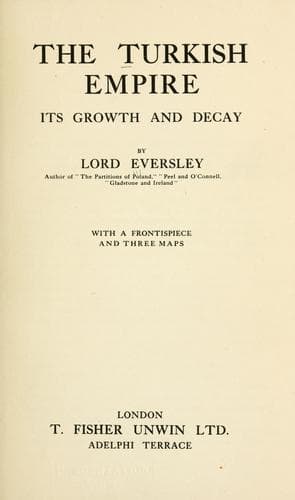
The Turkish Empire, Its Growth and DecayEversley, G. Shaw-Lefevre (George Shaw-Lefevre), Baron
History
The Turkish Empire, Its Growth and Decay
Eversley, G. Shaw-Lefevre (George Shaw-Lefevre), Baron
Turkey -- History
It has also been contended by some historians that it was unwise
policy to impose such a humiliation on the Czar as that embodied in
the treaty; that it was certain to lead to a renewal of the war for
the purpose of avenging it. But the Czar himself did not apparently
take this view of the case. After the escape of his army from disaster
he showed no inclination to renew the war. He was willing, two years
later, to re-enact the treaty, in spite of its humiliating terms. He
did not break peace with the Turks in the remaining ten years of his
reign. He did not bear a grudge against them and after a few years he
entered into an arrangement with the Sultan for the partition of a
large part of Persia.
On a review of the whole transaction, we must conclude that the Grand
Vizier Baltadji was fully justified in effecting the treaty of the
Pruth, and that it was no small achievement, by the skilful manœuvring
of his army and without the loss of a single life, to impose terms
on the Czar, under which the Ottoman Empire recovered Azoff and its
district, the key to the Crimea, and obtained the other valuable
concessions embodied in the treaty.
In 1715 the Porte embarked on another war, this time against the
Republic of Venice, with the object of recovering the Morea, which
sixteen years previously had been conquered by the Republic, when in
alliance with Austria, and the possession of which had been confirmed
to the Republic by the treaty of Carlowitz. Morosini, the Venetian
general by whom this conquest had been achieved, was now dead. It was
thought that Austria would not intervene. A pretext for the war was
found in the assistance which the Republic rendered to the Montenegrins
in an insurrection against the Porte. The army, which had been equipped
for war with Russia, was now available for other purposes. The Grand
Vizier Damad, who was also otherwise known as Coumourgi, son-in-law of
the Sultan, took command of an army of a hundred thousand men. A fleet
of one hundred sail co-operated by sea. The Sultan himself accompanied
the army as far as Larissa, in Thessaly, but no farther. He left the
direction of it wholly in the hands of Damad, who showed great ability
in the conduct of the war. It commenced with the siege of Corinth,
which, after a brave defence of three weeks, capitulated on July 7,
1715, on favourable terms. But a powder magazine blew up during the
evacuation of the fortress, killing six or seven hundred of the Turkish
soldiers. This afforded an excuse for breaking the agreement, and for
a general massacre of Venetians and Greeks, whether of the garrison or
inhabitants—much to the disapproval of Damad. This siege of Corinth
formed the subject of Lord Byron’s well-known poem, in which Damad is
referred to under the name of Coumourgi:—
Public-domain text, read in full here on John Shaqi.
Reviews
Reviews
No reviews yet
Be the first to share your thoughts on this work.
Elsewhere in the archive
Join the Discussion
Join the discussion
Sign in to leave a comment or review.
Sign InorCreate an account