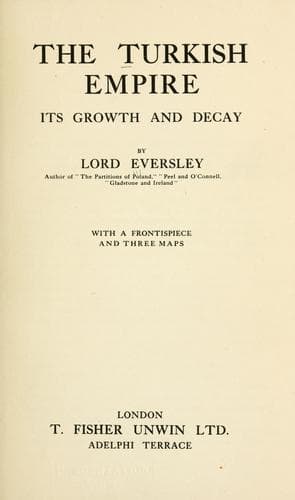
The Turkish Empire, Its Growth and DecayEversley, G. Shaw-Lefevre (George Shaw-Lefevre), Baron
History
The Turkish Empire, Its Growth and Decay
Eversley, G. Shaw-Lefevre (George Shaw-Lefevre), Baron
Turkey -- History
The Turks crossed the River Saave by a bridge of boats, and then
marched along the bank of the Danube towards Peterwardein. Their van
came in contact with that of the Austrians at the village of Carlowitz,
where, sixteen years before, the last treaty had been signed. From
Carlowitz to Peterwardein the distance is only two leagues. The
Austrian army, greatly inferior in numbers to that of the Turks, was
posted in front of the great fortress, behind entrenchments which had
been made by Siawousch Pasha in the last war. It was again commanded
by Prince Eugène of Savoy, who, in the interval, had gathered fresh
laurels in many hard-fought battles for Austria, and who was second to
no living general, save only the Duke of Marlborough, by whose side
he fought so many battles. The two armies came to issue on August
10, 1716. At first the battle went in favour of the Ottomans. Their
redoubtable Janissaries broke the line of the Austrian infantry opposed
to them. Prince Eugène then brought up his reserve of cavalry. They
charged the Janissaries with irresistible force, and retrieved the
fortunes of the day. Damad Pasha, when he saw that the tide of battle
was turning against him, put himself at the head of a band of officers
and galloped into the thick of the battle, in the hope of infusing
fresh courage in his army. He was struck down and was carried from the
field to Carlowitz, where he died.
As so often happened to the Turks, the loss of their leader caused a
panic in their ranks and completed their discomfiture. Their left wing
retreated in the direction of Belgrade, and was followed by the débris
of the rest of the army. One hundred and forty of their guns were
captured. Their camp and an immense booty fell into the hands of the
enemy. The battle, however, was not very costly in men to either side.
The Austrians lost three thousand men and the Turks about double the
number. Eugène followed up his success by the siege of Temesvar, the
last great stronghold of the Ottomans in Hungary. He appeared before it
twenty days after the battle of Peterwardein. Its garrison of eighteen
thousand men capitulated, after a siege of five weeks, on November
25th. This completed the campaign of 1716. The Turks had not been more
successful in other directions. They were compelled to raise the siege
of Corfu. Their fleet often met that of the Venetians and had rather
the worst of it, though there was no decisive battle.
Public-domain text, read in full here on John Shaqi.
Reviews
Reviews
No reviews yet
Be the first to share your thoughts on this work.
Elsewhere in the archive
Join the Discussion
Join the discussion
Sign in to leave a comment or review.
Sign InorCreate an account