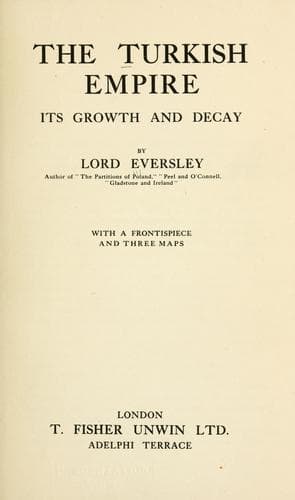
The Turkish Empire, Its Growth and DecayEversley, G. Shaw-Lefevre (George Shaw-Lefevre), Baron
History
The Turkish Empire, Its Growth and Decay
Eversley, G. Shaw-Lefevre (George Shaw-Lefevre), Baron
Turkey -- History
THE campaign, and the resulting treaty of Belgrade, saved the Ottoman
Empire from further shrinkage for many years. There followed a long
period of peace. This was due not merely to the fact that the Porte
pursued a policy of peace, but because the two great Powers in Europe,
Russia and Austria, who were bent on the dismemberment of Turkey,
were not in a condition to prosecute their aims, and were not able
to enter into any combination for the purpose. In 1740 the Emperor
Charles VI died. This event led to a scramble among the neighbouring
Powers for his inheritance, and to the war known as that of the
Austrian Succession, which was brought to an end by the Treaty of
Aix-la-Chapelle in 1748. This was followed later again by another war,
known as the Seven Years War, which was concluded in 1763. In neither
of these great wars did the Porte take any part, and it is to its
credit that it did not take advantage of them to attempt the recovery
from Austria of any of its lost dominions in Hungary. Till war broke
out with Russia in 1768 there was profound peace.
Sultan Mahmoud died in 1754 and was succeeded by his brother, Othman
II, who reigned for three years only. He was deformed—a hunchback. He
does not appear to have made any change in the foreign policy of his
government. In his three years of reign there were six Grand Viziers,
and it seems probable that the real power of the State was exercised by
the successor to the Kislaraga Bashir, from behind the curtain of the
harem.
Mustapha III succeeded his brother at the age of fifty. He had spent
his life up to this time in seclusion, in the Cage of the Seraglio,
cut off from all contact with, or even knowledge of, public affairs.
For the first six years of his reign he left matters very much in the
hands of his Grand Vizier, Raghab Pasha, the last of the many who had
filled this post under Mahmoud. Raghab proved to be a most wise and
competent statesman, not far behind Sokolli and the Kiuprilis, and,
like them, devoted to a policy of peace.
After the death of Raghab in 1763 Mustapha gradually took into his own
hands the reins of government. Though well-intentioned and with a sense
of public duty, he was feeble, hasty, and impatient, and was wanting
in the most essential faculty of a ruler, that of selecting competent
men as generals and administrators. He abandoned the policy of peace
and allowed himself to be drawn into war, with the most unfortunate
results to his Empire. It was his misfortune that his reign coincided
with those of two such able and unscrupulous neighbouring potentates as
Catherine II of Russia and Frederick the Great of Prussia.
Public-domain text, read in full here on John Shaqi.
Reviews
Reviews
No reviews yet
Be the first to share your thoughts on this work.
Elsewhere in the archive
Join the Discussion
Join the discussion
Sign in to leave a comment or review.
Sign InorCreate an account