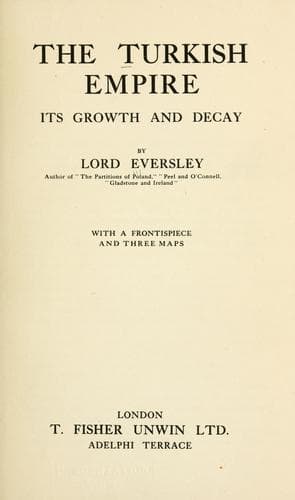
The Turkish Empire, Its Growth and DecayEversley, G. Shaw-Lefevre (George Shaw-Lefevre), Baron
History
The Turkish Empire, Its Growth and Decay
Eversley, G. Shaw-Lefevre (George Shaw-Lefevre), Baron
Turkey -- History
At a Divan held at Constantinople in October 1768 it was decided that
Russia, by its proceedings against Poland, had broken the treaty
of Belgrade, and that war against her would be just and necessary.
The only opposition to this came from the Grand Vizier, Mouhsinzade
Pasha. He did not, indeed, object in principle, but he maintained
that it was most unwise to declare war until full preparations had
been made for it. He pointed out that the frontier fortresses were in
a most unprepared state, and that as military operations could only
be commenced by the Turks in the next spring, Russia would be placed
in an advantageous position by an immediate declaration of war. For
this advice, which the sequel fully justified, the Grand Vizier was
dismissed from his office. In his place Emen Mahomet was appointed—a
most incompetent man, knowing nothing about military matters, by his
own admission. As a result of this premature declaration of war, Russia
had full notice, and entered on the campaign of 1769 in Moldavia
before the Porte was ready to send an army to defend that province.
The Empress put into the field three armies. The principal one, under
command of Prince Galitzin, invaded Moldavia and laid siege to Khoczim.
It was not till May 1769 that the Grand Vizier was in a position to
issue from his camp at Babatagli and march to Isakdji, near Ismail.
He there summoned his generals to a council of war and opened the
proceedings by an astounding admission of incompetence. Asking for
their opinion as to what direction his army should be led, he said, “I
have no experience of war. It is for you to determine what operation
shall be undertaken and what are the most favourable chances for the
army and the Sublime Porte. Speak without hesitation and enlighten me
by your counsel.”
The generals were struck dumb with astonishment at this confession of
ignorance and impotence. Eventually a discussion arose. There was great
difference of opinion. As a result, the only decision arrived at was
to cross the Danube into Moldavia, and then proceed as circumstances
might suggest. In fact, there was no definite plan of campaign. The
army, in accordance with this, crossed the Danube. It was then decided
to march to the River Pruth. It reached a point about half-way between
Khoczim and Jassy. But already it suffered greatly from want of food,
for which no preparations had been made. The soldiers also were
harassed by swarms of mosquitoes in the marshes of the Danube and the
Pruth. It was unable to prevent the capture of Khoczim by the Russians.
It was ultimately forced to retreat before coming into serious contact
with the enemy, and it found its way back to the Danube; and thus
concluded the campaign of 1769.
Public-domain text, read in full here on John Shaqi.
Reviews
Reviews
No reviews yet
Be the first to share your thoughts on this work.
Elsewhere in the archive
Join the Discussion
Join the discussion
Sign in to leave a comment or review.
Sign InorCreate an account