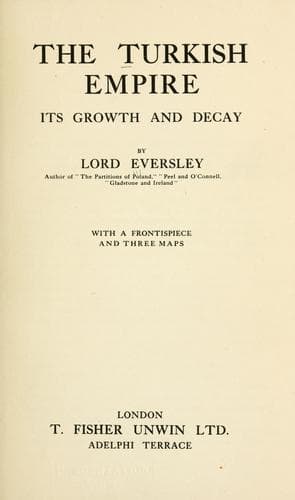
The Turkish Empire, Its Growth and DecayEversley, G. Shaw-Lefevre (George Shaw-Lefevre), Baron
History
The Turkish Empire, Its Growth and Decay
Eversley, G. Shaw-Lefevre (George Shaw-Lefevre), Baron
Turkey -- History
Meanwhile, in 1802, a peace was patched up for a time between England
and France at Amiens. Concurrently with this terms of peace were agreed
upon between France and the Porte, under which the sovereignty of the
Sultan over Egypt was recognized. When, two years later, war again
broke out between France and England and other Powers, Bonaparte, then
First Consul, reversed his action as regards the Ottoman Empire, and
made an alliance with it a cardinal point of his new policy.
After the conclusion of peace with France in 1802, Sultan Selim had
a respite for a very few years before he was again involved in war.
He directed his attention to serious internal reforms of his Empire.
He fully recognized that the first and foremost of these must be the
reorganization, if not the suppression, of the corps of Janissaries.
Not only had the experience of late wars shown that they had become a
most incompetent military force, quite unable to meet on equal terms
the well-trained soldiers of Russia and France, but in every part of
his Empire they were a danger to the State, endeavouring to monopolize
power and to oust that of the pashas appointed by himself. They were
also the main oppressors of the rayas. The task of suppressing them and
of creating an army on the model of those of European Powers was a most
difficult and dangerous one, for the Janissaries were, or pretended to
be, the most devout of Moslems, and were supported by the fanatical
part of the population. They had strong supporters in the Divan. The
ulemas were almost unanimously in their favour. The Divan was divided
into two parties, those who favoured reform and who gave support to the
Sultan, and the reactionary party, who were opposed to all reform and
championed the Janissaries. There was another serious division of the
Divan—namely those who espoused the cause of Russia, not infrequently
in the pay of that Power, and those who favoured France. After the
conclusion of peace, France was represented at the Court of the Sultan
by very able ministers, who soon regained the influence for that
country which it had formerly enjoyed.
Nowhere throughout the Empire were the Janissaries more turbulent and
dangerous or more oppressive to the rayas than in Serbia. They aimed at
governing the province in the same way as the Mamelukes in Egypt and
the military Begs in Algiers and Tunis, and if they had been allowed
to have their way, Serbia would have achieved a virtual independence
of the Porte, under a military and fanatical Moslem despotism. The
Janissaries there were almost as hostile to the Spahis inhabiting
the provinces as to the rayas. They aimed at ousting the Spahis from
their feudal rights in the country districts and at an assumption of
ownership of land, more oppressive to the peasant Christian cultivators
of the soil than that of the Spahis. Both Spahis and rayas appealed to
the Porte for protection against these ruffians. The rayas in their
petition to the Sultan said that—
Public-domain text, read in full here on John Shaqi.
Reviews
Reviews
No reviews yet
Be the first to share your thoughts on this work.
Elsewhere in the archive
Join the Discussion
Join the discussion
Sign in to leave a comment or review.
Sign InorCreate an account