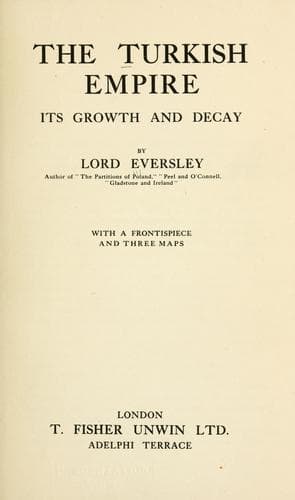
The Turkish Empire, Its Growth and DecayEversley, G. Shaw-Lefevre (George Shaw-Lefevre), Baron
History
The Turkish Empire, Its Growth and Decay
Eversley, G. Shaw-Lefevre (George Shaw-Lefevre), Baron
Turkey -- History
Bairactar, having succeeded in deposing Mustapha and installing
Mahmoud, most unwisely allowed the Bosnian and Albanian troops to
return to their homes. There remained only four thousand men as a
bodyguard on whom the new Sultan could rely. They were not sufficient
to withstand the Janissaries. These turbulent men broke out in another
rebellion. They attacked Bairactar in his palace. He took refuge in
a tower used as a powder magazine. He was there blown up, whether
by accident or wilfully is not known. There ensued a few days of
civil war. The artillery on whom the Sultan relied went over to the
Janissaries. A counter-revolution was effected. Mustapha would have
been restored to the throne if he had not been put to death in the
interval. Mahmoud owed his life to the fact that he was the last
surviving male of the Othman race. He was compelled to yield to the
menaces of the Janissaries, who were now masters of the city. An edict
was issued in his name which repealed all the reforms effected by
Selim. The old system was restored, with all its abuses. In the next
three or four years the Janissaries were virtually the rulers of the
Empire. Grand Viziers were appointed and dismissed at their dictation.
Mahmoud was greatly humiliated. But he bided his time, and it will
be seen that before long he inflicted a most bloody revenge on the
Janissaries and extinguished their corps for ever.
Meanwhile affairs on the Danube fared badly with the Turks, as might
be expected. The Russians gained complete possession of Moldavia and
Wallachia. Their armies crossed the Danube and laid siege to fortresses
on the right bank. In 1807 Russia and France came to terms. The treaty
of Tilsit provided that hostilities were to cease between Russia and
Turkey, and that the Russian troops were to be withdrawn from Moldavia
and Wallachia, till a definitive agreement had been come to between
these two Powers. But a secret article, which was not made public till
some time later, provided that all the European provinces of Turkey,
except Roumelia and Constantinople, were to be taken from the Sultan.
We now know that there were long discussions between Napoleon and the
Czar, on the River Niemen, as to the future disposal of these and
other provinces. Napoleon was ready to concede to Russia the Danubian
principalities and Bulgaria. He claimed for France Egypt, Syria,
Greece, all the islands of the Archipelago, and Crete. Austria was
to be propitiated by the cession of Bosnia and Serbia. The question
remained what was to be done with Constantinople. Napoleon would not
concede it to Russia. The Czar insisted upon this. The agreement
broke down on this point. But it is certain that Napoleon was willing
enough to throw over his recent allies, the Turks, and to join with
their hereditary foe in dismembering their Empire. A more perfidious
transaction is not to be found in history.
Public-domain text, read in full here on John Shaqi.
Reviews
Reviews
No reviews yet
Be the first to share your thoughts on this work.
Elsewhere in the archive
Join the Discussion
Join the discussion
Sign in to leave a comment or review.
Sign InorCreate an account