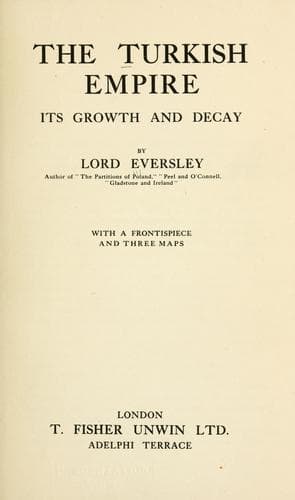
The Turkish Empire, Its Growth and DecayEversley, G. Shaw-Lefevre (George Shaw-Lefevre), Baron
History
The Turkish Empire, Its Growth and Decay
Eversley, G. Shaw-Lefevre (George Shaw-Lefevre), Baron
Turkey -- History
It has been shown that the revolution broke out in the Morea. Within a
few months the whole of that country was cleared of Ottoman troops and
of Moslem inhabitants. The outbreak extended to most of the islands of
the archipelago, where the Greeks predominated, where there was less
admixture of Slav blood than on the mainland, and where the traditions
of a long-past national existence and of high civilization survived in
a stronger form. In spite of their greater prosperity, due to milder
treatment at the hands of the Turks, they were ardently in favour of
independence. It was in the islands that the majority of Greek merchant
vessels were owned. They numbered between four and five hundred, and
were manned by twelve thousand Greek sailors. An active war fleet
was formed out of these vessels and sailors. They frequently met and
defeated the Turkish fleet. They made special use of fire ships, and
blew up or burnt many of the Turkish vessels and caused the greatest
alarm to the Turkish sailors.
In the course of the four years 1821-4, the Turks were generally
worsted by the Greek insurgents on land and sea. Not only the Morea,
but the parts of Greece north of the Gulf of Corinth up to the frontier
of Thessaly, including Athens—then reduced to a squalid, third-rate
town—and the islands of the archipelago, achieved a practical
independence. A national government and a representative assembly were
constituted. The outbreak in Greece roused the sympathies of great
numbers of persons in Western Europe, especially in England and France.
In spite of this, the Governments of these countries for long held
aloof and discouraged the rebellion, not wishing to see Turkey weakened
as against Russia. Lord Byron was an enthusiast for the Greeks, and in
1824 landed at Missolonghi and joined their army. But it cannot be said
that he effected much during the short time he survived there. He was
evidently disillusioned, like so many other Philhellenes who joined the
Greeks, by the discords, intrigues, and corruption of their leaders.
But he never lost faith in their future. He confidently predicted that
the Greek nation would prove itself worthy of freedom. He gave his
life to the cause. He died of malarial fever within a few weeks of
landing at this unhealthy spot. This did much to arouse the interest of
Europe and to promote its intervention on behalf of the Greeks.
Public-domain text, read in full here on John Shaqi.
Reviews
Reviews
No reviews yet
Be the first to share your thoughts on this work.
Elsewhere in the archive
Join the Discussion
Join the discussion
Sign in to leave a comment or review.
Sign InorCreate an account