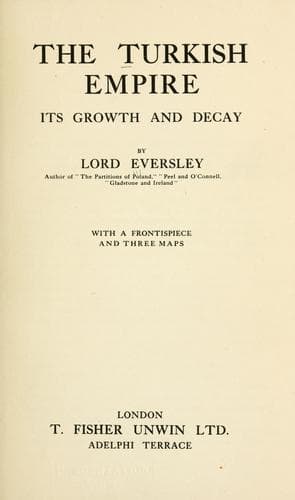
The Turkish Empire, Its Growth and DecayEversley, G. Shaw-Lefevre (George Shaw-Lefevre), Baron
History
The Turkish Empire, Its Growth and Decay
Eversley, G. Shaw-Lefevre (George Shaw-Lefevre), Baron
Turkey -- History
Two events now occurred which materially affected the position of
Turkey, and deprived Mahmoud of the fruits of his ably devised
policy. The one was the death of Alexander, the Emperor of Russia,
the other the decision of the British Government to intervene on
behalf of Greece. Alexander for some years past had been on the horns
of a dilemma. He had a deep sympathy for the subjects of the Ottoman
Empire who were members of the Greek Church, and a great aversion to
Turkish rule. But he also hated and feared revolution. He believed
in the divine right of rulers, however bad, and would take no step
to support the revolt of their subjects, however oppressive their
government. He feared that a dangerous precedent might be extended to
his own Empire. This conflict of views paralysed his action. He gave
no assistance to the Greek insurgents. So long as he lived there was
little hope that Greece would recover its independence. He died late
in 1825, and was succeeded by his brother, Nicholas, a much younger
and more vigorous man, and a truer exponent of Russian ideals. The new
Czar had no objection to insurrection if it was not directed against
his own government. He hated the Turks and wished to drive them out of
Europe much more than he sympathized with the Greeks. He had many other
grounds of complaint against the Porte. It has also been suggested that
he wished to come to conclusions with it before time had been given for
perfecting his new army.
As regards Great Britain, its Government had not originally sympathized
with the Greek revolution, but the reverse. But public opinion,
outraged by the barbarities which had been committed, had produced
an influence on it, and Mr. Canning, the Foreign Secretary, was
personally very favourable to the cause of Greece. The Government as a
whole held the view that the continuance of disorder in Greece was a
menace to the peace of Europe. They had no wish for the extension of
Russia at the expense of Turkey. They thought that if Greece were not
pacified Russia would intervene, and would not confine its claim to
the settlement of the Greek claims, but would aim at other conquests.
They decided, therefore, to make an effort to settle the Greek question
on the basis of autonomy, subject to the suzerainty of the Sultan. In
this view the Cabinet sent the Duke of Wellington to St. Petersburg in
1826 to negotiate with the Czar. He effected an arrangement which was
later embodied in the treaty of London of July 6, 1827, between the
three Powers, Great Britain, Russia, and France, for the pacification
of Greece. Under the terms of this treaty it was agreed, with a view
to bringing about a reconciliation between the Ottoman Porte and the
Greeks, to offer mediation, and to demand an immediate armistice as a
preliminary to the opening of a negotiation.
Public-domain text, read in full here on John Shaqi.
Reviews
Reviews
No reviews yet
Be the first to share your thoughts on this work.
Elsewhere in the archive
Join the Discussion
Join the discussion
Sign in to leave a comment or review.
Sign InorCreate an account