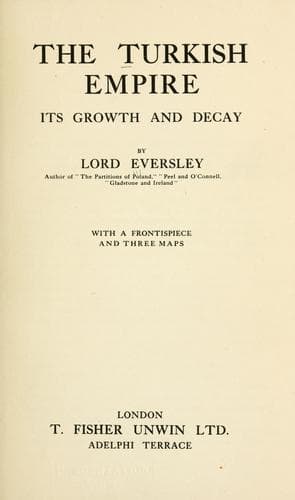
The Turkish Empire, Its Growth and DecayEversley, G. Shaw-Lefevre (George Shaw-Lefevre), Baron
History
The Turkish Empire, Its Growth and Decay
Eversley, G. Shaw-Lefevre (George Shaw-Lefevre), Baron
Turkey -- History
All danger of an advance by the Russians across the Danube and the
Balkans was now at an end. The Turks unaided had effectually prevented
any such project. The Russian army thereupon retreated from the
Danubian principalities. Their place there was taken by an Austrian
army, with the consent of both Russia and the two Western Powers. No
reason existed, therefore, why the war should be continued, so far as
England and France were concerned. There was no longer any necessity
for their armies to defend the frontiers of Turkey. But a war spirit
had been roused in the two countries and was not to be allayed without
much shedding of blood. The two Powers decided to use their armies
which had been collected at Varna for the invasion of the Crimea and
the destruction of the naval arsenal at Sebastopol, which was regarded
as a permanent menace to Turkey.
Thenceforth, the part of the Turks in the war became subordinate and
even insignificant. The war was fought _à outrance_ between the two
allied Powers and Russia. The successful landing of the two armies
at Eupatoria, in the Crimea, their splendid victory over the Russian
army at the Alma, their flank march to the south of Sebastopol, the
commencement of the long siege of that fortress, the famous battles
of Balaklava and Inkerman and the terrible sufferings of the British
army in the winter of 1854-5, the memorable defence of Sebastopol
under General Todleben, the capture of the Malakoff by the French on
September 8th, 1855, and the consequent evacuation of the city and
forts of Sebastopol, on the southern side of its great harbour, are
events of the deepest interest in the histories of the allied Powers
and Russia, but have comparatively little bearing on our present theme.
Very little use was, in fact, made of the Turkish army by the Allies
in the course of the war. A division of seven thousand men was sent to
the Crimea in the autumn of 1854, and was employed for the defence of
Balaklava. It was led by most incompetent officers, and when attacked
by the Russians on the morning of the Battle of Balaklava, the men
precipitately fled. This exposed the flank of the allied army to
great danger. Later, another Turkish force under Omar Pasha was sent
to Eupatoria. It was attacked there by a much superior Russian army,
early in 1855, and fighting behind earthworks it made a very effective
resistance and completely repulsed the Russians. It was said that the
humiliation of this defeat of his troops by the despised Turks was the
immediate cause of the death of the Emperor Nicholas.
Public-domain text, read in full here on John Shaqi.
Reviews
Reviews
No reviews yet
Be the first to share your thoughts on this work.
Elsewhere in the archive
Join the Discussion
Join the discussion
Sign in to leave a comment or review.
Sign InorCreate an account