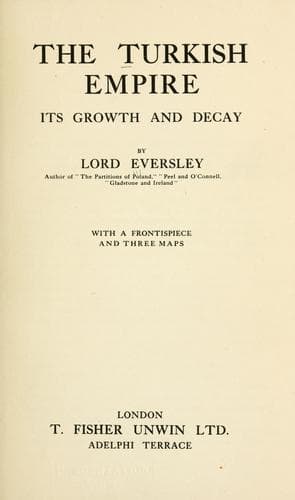
The Turkish Empire, Its Growth and DecayEversley, G. Shaw-Lefevre (George Shaw-Lefevre), Baron
History
The Turkish Empire, Its Growth and Decay
Eversley, G. Shaw-Lefevre (George Shaw-Lefevre), Baron
Turkey -- History
Under the terms of this treaty all the territories conquered by Russia
in Asia or by the allied Powers in Europe were restored to their
former owners. The small part of Bessarabia conceded to Russia by the
treaty of Bucharest and giving access to the Danube was reannexed to
Moldavia. The exclusive protectorate of Russia over the two Danubian
principalities was abolished, and they were placed under the joint
protection of all the Great Powers. The suzerainty of the Sultan over
them was recognized. But the Porte engaged to preserve for them an
independent and national administration, with full liberty of worship,
of legislation, and of commerce. They were to be permitted to organize
national armed forces. Serbia was accorded the same treatment, except
as regards a national army, but the armed intervention of the Porte
was to be permitted only with the consent of the Powers who were
signatories to the treaty. The Black Sea was neutralized. It was thrown
open to the mercantile marine of all nations, but was interdicted
to the war vessels of either Russia or Turkey, and these two Powers
engaged not to establish or maintain any military maritime arsenals on
its coasts.
As regards the internal administration of Turkey and the treatment of
its Christian population, the treaty contained the following clause:—
The Sultan, having by his constant solicitude for the welfare of
his subjects issued a firman (the Hatti-Humayun), which, while
ameliorating their condition without distinction of religion or race,
records his generous intentions towards the Christian population of
his Empire, and wishing to give a further proof of his sentiments in
that direction, has resolved to communicate to the contracting Powers
the said firman emanating spontaneously from his sovereign will. The
contracting Powers recognize the high value of this communication.
It is clearly understood that it cannot give to the said Powers
the right to interfere either collectively or individually in the
relations of H.M. the Sultan with his subjects or in the internal
administration of his Empire.
The latter part of the clause, it will be seen, completely nullified
and destroyed the effect of the earlier part of it, and practically
gave full licence to the Sultan to continue his misgovernment of his
Empire and to refuse the just demands of his Christian subjects—a very
lame and impotent conclusion to the war.
Public-domain text, read in full here on John Shaqi.
Reviews
Reviews
No reviews yet
Be the first to share your thoughts on this work.
Elsewhere in the archive
Join the Discussion
Join the discussion
Sign in to leave a comment or review.
Sign InorCreate an account