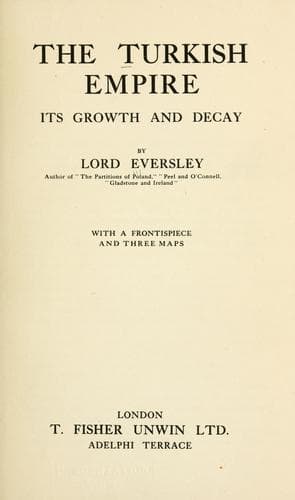
The Turkish Empire, Its Growth and DecayEversley, G. Shaw-Lefevre (George Shaw-Lefevre), Baron
History
The Turkish Empire, Its Growth and Decay
Eversley, G. Shaw-Lefevre (George Shaw-Lefevre), Baron
Turkey -- History
Lord Clarendon, in a letter to the ambassador, thus described his own
views of the treaty:—
I think as you do about the terms of peace, but I am not the least
sorry that peace is made, because, notwithstanding our means of
carrying on the war, I believe we should have run risks by so doing
for which no possible success would have compensated. We should have
been alone.... If you could have seen all that was passing when I
got to Paris—the bitterness of feeling against us, the kindly (I
might almost say the enthusiastic) feeling towards Russia, and the
determination, if necessary, to throw over the Vienna conditions in
order to prevent the resumption of hostilities (money matters and
Bourse speculations being the main cause), you would have felt as
I did, that our position was not agreeable, and that Brunnow was
justified in saying that they did not come to make or negotiate
peace, but to accept the peace which was to be crammed down their
throats.... Unluckily, too, just as negotiations began the French
army fell ill, and the Emperor himself admitted to me that, with
twenty-two thousand men in hospital and likely to be more, peace
had almost become a military as well as a financial and political
necessity for him.[37]
Lord Stratford’s words on hearing that the treaty was signed were, “I
would rather have cut off my right hand than have signed that treaty.”
The writer paid a second visit to Constantinople in 1857. He rode there
from Belgrade, passing through Bulgaria on the way, and was witness
of the miserable condition to which this province had been reduced by
Ottoman rule. He spent a few weeks at Therapia, where the Ambassador
was residing, and was favoured by many conversations with him. Lord
Stratford was always most kind and communicative to young men. He
made no secret of his bitter disappointment. The treaty of Paris, he
alleged, was a death-blow to the cause of reform in Turkey. If the
Christian population were not protected from misgovernment, the Empire
was doomed. He was under no illusion as to the misgovernment of the
country. He knew that if left to themselves the Turks would do nothing,
and that all the reforms promised by the Hatti-Humayun which he had
obtained with so much labour and difficulty before the conclusion of
the Crimean War would remain unexecuted and would be a dead letter.
He considered that England had been betrayed at the Congress of
Paris, that the clause in the treaty which embodied the Hatti-Humayun
was nullified by the provision that its recognition did not entitle
the Great Powers either collectively or separately to interfere in
the internal affairs of Turkey. He held that this was fatal to the
enforcement of the new reforms. He maintained that the only way to
induce the Turks to act in accordance with them was through threats
and fear, and that some external Power should bring such pressure to
bear on them. This might be done by England alone, or by England in
Public-domain text, read in full here on John Shaqi.
Reviews
Reviews
No reviews yet
Be the first to share your thoughts on this work.
Elsewhere in the archive
Join the Discussion
Join the discussion
Sign in to leave a comment or review.
Sign InorCreate an account