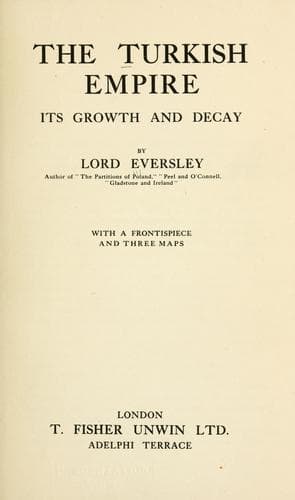
The Turkish Empire, Its Growth and DecayEversley, G. Shaw-Lefevre (George Shaw-Lefevre), Baron
History
The Turkish Empire, Its Growth and Decay
Eversley, G. Shaw-Lefevre (George Shaw-Lefevre), Baron
Turkey -- History
The reign was chiefly conspicuous for the enormous borrowings of money
in London and Paris by the Porte, following on the bad example set by
Abdul Mehzid. The debt was rapidly increased by Abdul Aziz till it
reached a total of nearly two hundred millions sterling. It does not
appear that the accruing interest on this great debt was ever paid out
of the revenues of the Empire. Fresh loans were continually raised, out
of which the accumulated interest on previous loans was provided. Huge
commissions to financiers who brought out the loans, and bribes to
pashas for consenting to their issue, accounted for another large part
of the borrowed money. What remained was mainly devoted by the Sultan
to new palaces and to extravagances of his harem. This merry game went
on as long as credulous people in Western Europe could be induced to
continue lending. But the credit of the Turkish Empire was exhausted in
1874. A repudiation of half of the interest was then announced, and in
the following year the remaining half was repudiated. This did much to
weaken the interest of Western Europe in the Turkish cause. Eventually
a composition was arrived at with the creditors of the State. An
International Commission was appointed, in whom certain revenues of the
State were vested, out of which the interest of a greatly reduced total
of the original debt was to be paid. The principle of foreign control
over the finance of the Empire was thus introduced.
The Russian Government during this reign, by its skilful diplomacy,
backed by threats of force, recovered much of its old influence at
the Porte, and its ambassador, General Ignatief, began to dominate
its councils and to nominate its Grand Viziers. Three events during
the period showed the gradual downward course of the Empire. In 1867
the two Danubian principalities succeeded in accomplishing their
long-desired object of uniting together in a single State, thenceforth
known as Roumania; and in 1868 Prince Charles of Hohenzollern was
elected, and was invested by the Sultan as the hereditary ruler of
this new State. The union of the two provinces into a single State
practically secured independence to it, while the connection of its
ruler with the reigning family of Prussia marked the advent of that
Power into the political system of the Christian States founded on
the débris of the Turkish Empire in Europe, and was the first of many
important alliances of which we now see the intent and result. Serbia
also made an important advance to independence. In 1867 the Turkish
garrison in Belgrade, the occupation of which had been confirmed by the
treaty of Paris, was withdrawn by the Porte. These two events were the
result of pressure of the ambassadors of the Great Powers, who were
anxious to minimize the causes of friction to the Porte, which did not
add to its real strength.
Public-domain text, read in full here on John Shaqi.
Reviews
Reviews
No reviews yet
Be the first to share your thoughts on this work.
Elsewhere in the archive
Join the Discussion
Join the discussion
Sign in to leave a comment or review.
Sign InorCreate an account