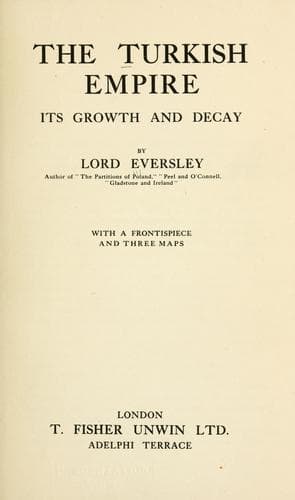
The Turkish Empire, Its Growth and DecayEversley, G. Shaw-Lefevre (George Shaw-Lefevre), Baron
History
The Turkish Empire, Its Growth and Decay
Eversley, G. Shaw-Lefevre (George Shaw-Lefevre), Baron
Turkey -- History
Mr. Disraeli, who was created Earl of Beaconsfield in the course of
these events, on his retirement from the House of Commons, showed great
courage and persistence in resisting the movement. His sympathies lay
wholly in the opposite direction. His Eastern policy was in accord
with that of the previous generation of statesmen, such as Palmerston,
and, indeed, Gladstone himself in his earlier stage of opinion, who
believed that the maintenance of the Turkish Empire was essential
to the integrity of the British Empire. He saw no reason for change.
He dreaded the further advance of Russia. He did not believe in the
honesty of the professions of its Emperor. He enforced his views at a
public meeting at Aylesbury on September 20th, and endeavoured to stem
the movement. He scoffed at the Bulgarian horrors. He declared the
perpetrators of them were not so bad as those who made them the subject
of agitation for their political purposes. He was evidently prepared to
support the Turks against any invasion of their country by Russia, and
to renew the policy of the Crimean War. But it was in vain.
Though the agitation promoted by Mr. Gladstone did not result in
inducing the Government to join the other Powers in compelling the
Turkish Government to concede autonomy to its Christian provinces,
or to carry out reforms, it had two effects of great historical
importance, which must be our justification for referring to the
subject. It made impossible the renewal of the policy of the Crimean
War—the armed support by Great Britain to the Turks against an invasion
by Russia on behalf of the Christian population of the Balkans. It
paralysed the hands of those, like Lord Beaconsfield, who desired
to support the Turks and the _status quo_. On the other hand, it
doubtless stimulated Russia to armed intervention, by making it clear
that there would be no resistance on the part of Great Britain. Lord
Beaconsfield’s Cabinet was divided on the subject. A majority of its
members evidently concurred with Lord Derby, the Foreign Secretary, in
opposition to war with Russia on behalf of Turkey.
On September 21st, the day after Lord Beaconsfield had delivered
his fiery pro-Turkish speech at Aylesbury, Lord Derby, on behalf of
the Government, in a despatch to the Ambassador at Constantinople,
directed him to inform the Porte that the atrocious crimes of the
Turkish authorities and troops in Bulgaria had aroused the righteous
indignation of the British people, and that Great Britain, as signatory
to the treaty of Paris, could not be indifferent to them. He demanded
that examples should be made of the perpetrators of these crimes.
Public-domain text, read in full here on John Shaqi.
Reviews
Reviews
No reviews yet
Be the first to share your thoughts on this work.
Elsewhere in the archive
Join the Discussion
Join the discussion
Sign in to leave a comment or review.
Sign InorCreate an account