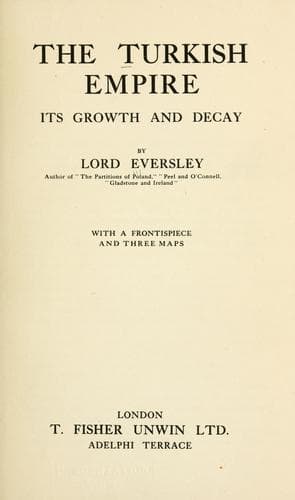
The Turkish Empire, Its Growth and DecayEversley, G. Shaw-Lefevre (George Shaw-Lefevre), Baron
History
The Turkish Empire, Its Growth and Decay
Eversley, G. Shaw-Lefevre (George Shaw-Lefevre), Baron
Turkey -- History
There remains the case of the Macedonians and other people of the
Balkans who were replaced by the treaty of Berlin under Ottoman rule.
The difficulty of dealing with them was aggravated by the fact that the
population of these districts was not homogeneous. Bulgarians, Greeks,
and Serbians were in many districts mixed up, each with separate
villages or communities, so that no definite geographical lines could
be drawn between them. The neighbouring States of Bulgaria, Serbia,
and Greece were furiously jealous of one another, each claiming these
intervening districts. This, however, was no excuse to the Porte for
the continued misgovernment of these provinces. Their unfortunate
populations, while enduring the evils of misrule, were able to compare
their position under Turkish rule with that of their more fortunate
neighbours who had been liberated from it by the treaty of Berlin, and
were enjoying all the benefits of self-government in Bulgaria, Serbia,
and Greece.
The writer had the opportunity of personally forming an opinion on
this subject. In 1887 and 1890 he paid visits to Greece, and in 1890
he visited Bulgaria on his way to Constantinople, staying a few days
at Sofia and Philippopolis. In both cases he was able to compare the
new condition of things with what he recollected of his previous
visits to these districts in 1857. Nothing could be more striking and
more satisfactory to those who had felt confidence in the principle
of self-government and of democratic institutions. The change in
Bulgaria was the more remarkable as it had been effected in the twelve
years which had elapsed since the treaty of Berlin. In these few
years the Bulgarians had equipped themselves with the machinery of a
progressive democratic community, with schools and colleges, and with
compulsory education. Roads, harbours, and improvements of all kinds
were in course of construction. The Tartars and Circassians who had
been planted in Bulgaria by the Porte after the conquests by Russia
of the Crimea and the Caucasus, and who were the main instruments of
the horrors of Batak, had again been transplanted by the Porte in Asia
Minor. But the indigenous Moslems, whether of Slav or Turkish race, in
spite of vehement exhortations of their mollahs, remained and were
well treated by the Christian population now in possession of power.
They had no cause for complaint. They were represented in the National
Assembly of Bulgaria by not a few men of their own religion.
Public-domain text, read in full here on John Shaqi.
Reviews
Reviews
No reviews yet
Be the first to share your thoughts on this work.
Elsewhere in the archive
Join the Discussion
Join the discussion
Sign in to leave a comment or review.
Sign InorCreate an account