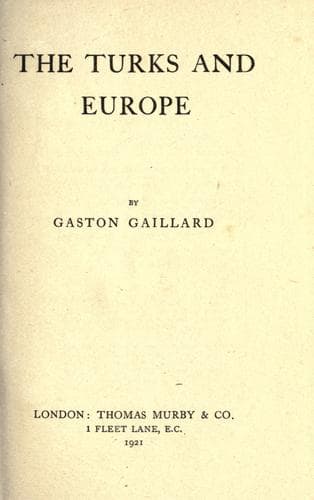
Treaty of Sèvres (1920); World War, 1914-1918 -- Territorial questions -- Turkey; World War, 1914-1918 -- Turkey
During Abdul Hamid’s reign Ahmed Riza had of his own will gone into
exile, and from Paris he had wielded great influence over the movement
that led to the revolution of 1908. But when the Young Turk Government
had practically become dictatorial and had yielded to the pressure
that drove it towards Germany, he realised that policy was a failure
and was leading the Empire to ruin; then, though he had been one of
the promoters of the movement, he protested repeatedly in the Senate,
of which he was a member, against the illegal doings of the Government
and its foolhardy policy. As President of the “National Block”—which,
though not a political party properly speaking, aimed at grouping all
the conservative constitutional elements friendly to the Entente—he
seemed likely to play an important part in public life again when,
about the middle of August, 1919, it was rumoured that the Damad Ferid
Government was about to take action against him and his political
friends; and soon after it was made known that he intended to go to
Italy or France till the reopening of the Ottoman Parliament. After
staying in Rome, where he had conversations with some political men of
note in order to establish an intellectual entente between Italians and
Turks, he settled in Paris.
The English censorship, which gagged the Turkish newspapers, went so
far as to prevent them from reprinting extracts from French newspapers
that were favourable to the Ottoman cause. It brought ridicule
upon itself by censuring the Bible; in an article in the _Univers
Israélite_, reprinted by the _Aurore_, which quoted and commented on
three verses of chapter xix. of Isaiah, the censor cut off the first
of these verses, which may be interpreted as foreshadowing a League of
Nations, but in which he was afraid the reader might find a hint at a
connection between Egypt and Asia and at the claims of the Turkish and
Egyptian Nationalists. This is the verse, which any reader could easily
restore: “In that day shall there be a highway out of Egypt to Assyria,
and the Assyrian shall come into Egypt and the Egyptian into Assyria,
and the Egyptians shall serve with the Assyrians.”
Footnotes:
21: Cf. the _Matin_, June 17, 1920, an interview of M. Paul
Benazet, ex-chairman of the Committee of War Estimates; and the
_Œuvre_, July 8, 1920.
22: Cf. the _Matin_, June 21, 1920, and M. Fribourg’s speech in the
second sitting of June 25, 1920.
23: _Figaro_, March 18, 1920.
24: Radet, _La Lydie et le monde grec au temps des Mermnades_
(Paris, 1893).
25: Oppert, _Le Peuple des Mèdes_.
VI
THE TREATY WITH TURKEY
Public-domain text, read in full here on John Shaqi.
Reviews
Reviews
No reviews yet
Be the first to share your thoughts on this work.
Elsewhere in the archive
Join the Discussion
Join the discussion
Sign in to leave a comment or review.
Sign InorCreate an account