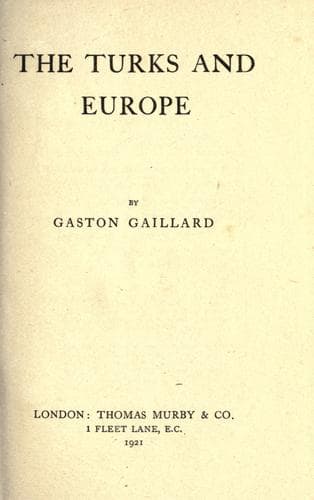
Treaty of Sèvres (1920); World War, 1914-1918 -- Territorial questions -- Turkey; World War, 1914-1918 -- Turkey
The first delegation was to include an aide-de-camp of the War
Minister, and an Allied superior officer. Another delegation was to
consist of members of Parliament, among whom were Youssouf Kemal Bey,
member for Sivas; Vehbi Bey, member for Karassi; Abdulla Azmi Bey,
member for Kutahia; and Riza Nuri, member for Sinope, the very man
who had brought in a motion against the occupation of Constantinople
and the arrest of some members of the Ottoman Parliament, and who was
credited with having said: “Anatolia has a false conception of the
occupation of Constantinople. We are going to give clear explanations
of the seriousness of the situation in order to avoid disastrous
consequences. We are going to tell Anatolia the ideas of the Government
about the interests of the nation.”
An Imperial decree prescribed the dissolution of the Chamber, and the
members before whom it was read left the Chamber quietly.
But it was obvious that the Damad Ferid Pasha Cabinet no longer
represented the country, and that in the mind of most Turks it could
no longer express or uphold the free will of the Turkish people, whose
hidden or open sympathies, in view of the foreigner’s threat, were
given to the Nationalist movement.
* * * * *
It must be owned that the Turkish Nationalist movement had at the
outset co-operated with some questionable elements and had been mixed
up with the intrigues of the former members of the Committee of Union
and Progress. But it now became impossible, in order to belittle it,
to look down upon it as a mere plot or insurrectionary movement. In
consequence of the successive events that had taken place since the
armistice and of the attitude of the Allies, especially England, after
the occupation of Constantinople, carried out under British pressure
with the approbation of the French Government notwithstanding the
protest of the French Press, and in view of the provisions that were
likely to be included in the Peace Treaty, Turkish patriotism, which
could not allow Turkey to be destroyed and meant to maintain her
traditional rights, had tacitly joined that movement. Besides, Mustafa
Kemal, who, at the very outset, had been a member of the Committee of
Union and Progress, had soon disagreed with Enver, and it should be
borne in mind that he was his enemy during the greater part of the war,
as he was an opponent of the German Marshal Falkenhayn. Some people
have tried to make out there was only personal enmity between them, and
have denied the possibility of political opposition; but the very fact
that their enmity would have ruined any common political designs they
might have had proves there were no such designs.
So Mustafa Kemal did not seem greatly moved by the measures mentioned
in the manifesto issued by the Government under pressure of the foreign
occupation and amidst the perturbation caused by recent events.
Public-domain text, read in full here on John Shaqi.
Reviews
Reviews
No reviews yet
Be the first to share your thoughts on this work.
Elsewhere in the archive
Join the Discussion
Join the discussion
Sign in to leave a comment or review.
Sign InorCreate an account