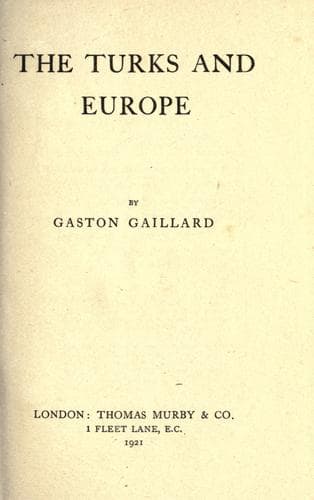
Treaty of Sèvres (1920); World War, 1914-1918 -- Territorial questions -- Turkey; World War, 1914-1918 -- Turkey
“The Turks cannot in any way, in this age of liberty and
democracy, acknowledge a peace that would lower them to the level
of an inferior race and would treat them worse than the Hungarians
or Bulgarians, who have lost comparatively small territories,
whereas Turkey is to be utterly crippled. We want to be treated
as a vanquished people, not as an inferior people or a people
in tutelage. The victors may have a right to take from us the
territories they conquered by force of arms; they have no right to
intrude into our home affairs. The Turkish people will willingly
grant concessions of mines and public works to the foreigners who
offer it the most profitable conditions; but it will never allow
the arbitrary partition of the wealth of the nation. To get riches
at the expense of an unfortunate nation is immoral; it is all the
more unfair as the responsibility of Turkey in the world war is
comparatively slight as compared with that of Austria-Germany and
Bulgaria. In respect of the crimes and atrocities against Armenia
and Greece which the Turks are charged with, we deny them earnestly
and indignantly. Let a mixed international commission be formed,
and sent to hold an impartial inquiry on the spot, and we pledge
ourselves to submit to its decisions. Till such an inquiry has
proved anything to the contrary, we have a right to look upon all
charges brought against us as slanders or mere lies.
“The Sublime Porte had already, on February 12, 1919, addressed to
the High Commissioners an official note requesting that neutral
States should appoint delegates charged to inquire into facts and
establish responsibilities; but the request of the Ottoman Cabinet
has hitherto been in vain, as well as that of the League for
National Ottoman Unity made on March 17 of the same year.
“Yet the report of the international Commission of Inquiry
assembled at Smyrna, which proved the charges of cruelty brought
against the Turks were unfounded, should induce the Allies, in the
name of justice, to hold an inquiry into the massacres supposed to
have taken place in Cilicia and elsewhere.
“I hope Your Excellency will excuse me if this letter is not
couched in the usual diplomatic style, and will consider that when
the life and rights of his nation are so grievously endangered it
is most difficult for a patriot to keep his thoughts and feelings
under control.”
As early as April 19, the San Remo Conference, which seemed to have
come to an agreement about the main lines of the treaty to be submitted
to Turkey, but had not yet settled the terms of this treaty, decided to
summon the Ottoman plenipotentiaries to Paris on May 10.
In a note sent on April 20, 1920, to M. Nitti, as president of the
San Remo Conference, Ghalib Kemaly Bey, formerly Ottoman minister
plenipotentiary to Russia, now living in Rome, wrote:
Public-domain text, read in full here on John Shaqi.
Reviews
Reviews
No reviews yet
Be the first to share your thoughts on this work.
Elsewhere in the archive
Join the Discussion
Join the discussion
Sign in to leave a comment or review.
Sign InorCreate an account