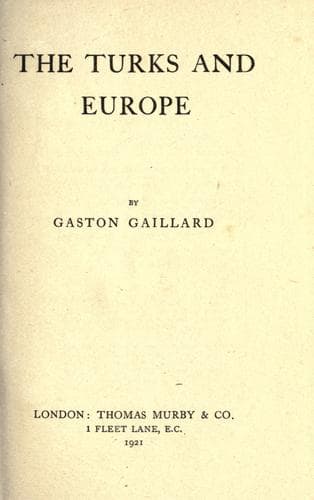
Treaty of Sèvres (1920); World War, 1914-1918 -- Territorial questions -- Turkey; World War, 1914-1918 -- Turkey
“Fourthly, the Turkish people, feeling sure that the peace
conditions are tantamount to suppressing Turkey as a nation, ask
that the treaty should be modified so as to be made more consistent
with right and justice.
“Fifthly, the aforesaid resolutions shall be submitted to the
Allied High Commissioners and forwarded to the Peace Conference.”
These resolutions were handed after the meeting to M. Defrance, the
senior Allied High Commissioner, who was to forward them to the Peace
Conference.
As the difficulties increased, and more important and quicker
communications with the Ottoman delegation in Paris were becoming
necessary, the Cabinet thought of sending the Grand Vizier to Paris.
Upon the latter’s advice, and probably at the instigation of the
English, several members of the dissolved Chamber set off to Anatolia
in order to try and bring about an understanding between Damad
Ferid and the Nationalists, for the conditions of the treaty, as
was to be expected, had now nearly healed the rupture between the
Central Government and the Turkish Nationalists, especially as the
Anglo-Turkish Army was unable to carry out the treaty and Damad Ferid
and his supporters were neither willing nor able to enforce it. Even
the English had sent delegates to Mustafa Kemal, who had refused to
receive them.
The Grand Vizier, after reviewing the troops at Ismid, found they were
not strong enough, and requested the headquarters merely to stand on
the defensive. Indeed, after a slight success in the Gulf of Ismid, the
Government forces found themselves in a critical condition, for the
Anatolian troops had occupied Kum Kale, close to the Dardanelles, and
Mustafa Kemal had concentrated forces in that region.
The Chamber, which had been dissolved at Constantinople, resumed its
sittings at Angora. It criticised the Allies’ policy with regard
to Turkey, especially the policy of England, at whose instigation
Constantinople had been occupied and military measures had been taken
on the coasts of the Black Sea.
In the speech he delivered at the first sitting of the Chamber, Mustafa
Kemal showed that the English occupation of Constantinople had been a
severe blow at the prestige of the Caliph and Sultan. “We must do our
best,” he said, “to free the Sultan and his capital. If we do not obey
his orders just now, it is because we look upon them as null and void,
as he is not really free.”
The same state of mind showed itself in a telegram of congratulation
addressed to the Sultan on his birthday by the provisional vali of
Angora, who, though he did not acknowledge the power of the Central
Government, stated that the population of Angora were deeply concerned
at the condition to which the seat of the Caliphate and Sultanry was
reduced owing to the occupation of Constantinople. This telegram ran
thus:
Public-domain text, read in full here on John Shaqi.
Reviews
Reviews
No reviews yet
Be the first to share your thoughts on this work.
Elsewhere in the archive
Join the Discussion
Join the discussion
Sign in to leave a comment or review.
Sign InorCreate an account