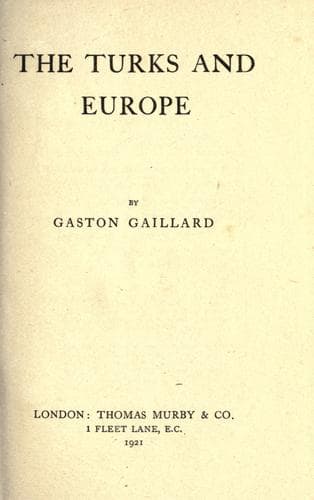
Treaty of Sèvres (1920); World War, 1914-1918 -- Territorial questions -- Turkey; World War, 1914-1918 -- Turkey
In 1890 the _Huntchag_ and _Tashnaktsutioun_ committees stirred up
riots at Erzerum, and in 1894 at Samsun, where the Patriarch Ashikian
was fired at, as has just been seen. In 1905 the Tashnakists started a
new insurrection. The rebellion extended to Amasia, Sivas, Tokat, Mush,
and Van, and the committees endeavoured to spread and intensify it. In
1905-06 the manœuvres of the Armenian committees succeeded in rousing
hostile feelings between Kurds and Armenians, which no reform whatever
seemed able to soothe. And in 1909-10, when new troubles broke out, the
revolutionary leaders openly attacked the Government troops.
Two years after the confiscation and handing over to the Ottoman
Government of the Armenian churches on June 21, 1903, massacres
took place at Batum on February 6, 1905, and later on at Erivan,
Nakhitchevan, Shusha, and Koshak. In 1908 the Tsar’s sway in the whole
of Caucasus became most oppressive, and a ukase prescribed the election
of a new catholicos to succeed Mgr. Krimian, who had died in October,
1907. Mgr. Ismirlian was appointed in his stead in 1908. By that time
the Russian sway had become so oppressive that the Tashnakists took
refuge in Constantinople, where the Young Turks openly declared in
favour of the Russian Armenians.
* * * * *
It might have been expected that after the proclamation of the
Constitution the committees, who had striven to hurry on the downfall
of the Empire through an agitation that might have brought about
foreign intervention, would put an end to their revolutionary schemes
and turn their activity towards social and economic questions.
Sabah-Gulian, a Caucasian by birth, president of the _Huntchag_, at
a meeting of this committee held in 1908 in Sourp-Yerourtoutioun
church at Pera, speaking of the Huntchagists’ programme and the
constitutional régime, declared: “We, Huntchagists, putting an end to
our revolutionary activity, must devote all our energy to the welfare
of the country.” On the other hand Agnoni, a Russian by birth, one of
the presidents of the _Tashnaktsutioun_, stated that “the first duty
of the Tashnakists would be to co-operate with the Union and Progress
Committee in order to maintain the Ottoman Constitution and ensure
harmony and concord between the various elements.”
Public-domain text, read in full here on John Shaqi.
Reviews
Reviews
No reviews yet
Be the first to share your thoughts on this work.
Elsewhere in the archive
Join the Discussion
Join the discussion
Sign in to leave a comment or review.
Sign InorCreate an account