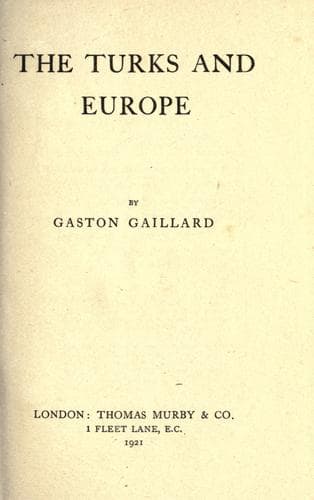
Treaty of Sèvres (1920); World War, 1914-1918 -- Territorial questions -- Turkey; World War, 1914-1918 -- Turkey
In 1913 Russia proposed a scheme of reforms to be instituted in
Armenia. It was communicated by M. de Giers to the Six Ambassadors’
Conference, which appointed a commission to report on it. As the German
and Austrian representatives raised objections to the Russian scheme
before that Commission of Armenian Reforms, which met from June 20 to
July 3, 1913, at the Austrian embassy at Yeni Keui, Russia, after this
defeat, strove to bring over Germany to her views.
In September, 1913, M. de Giers and M. de Wangenheim came to terms
on a programme to which the Porte opposed a counter-proposal. Yet
the Russian representatives succeeded in concluding a Russo-Turkish
agreement, January 26 to February 8, 1914.
When the scheme of reforms was outlined, and the powers and
jurisdiction of the inspectors and their staff were settled, the
Catholicos sent a telegram of congratulation to M. Borghos Nubar and
the latter sent another to M. Sazonov, for the Armenian committees
considered the arrangement as a first step towards autonomy. Encouraged
by this first success, the committees exerted themselves more and more.
The _Tashnaksutioun_ transferred its seat to Erzerum, where it held a
congress. The _Huntchag_ committee sent to Russia and Caucasus several
of its most influential members to raise funds in order to foment
a rising to attack the Union and Progress party especially, and to
overthrow the Government. Such was the state of things when war broke
out.
The Patriarch, who passed himself off as representing the Armenian
people, gathered together under his presidency the leaders of
the _Tashnaktsutioun_, the _Huntchag_, the _Ramgavar_, and the
_Veragaznial-Huntchag_, and the members of the National Assembly who
were affiliated to these committees to decide what attitude they were
to take in case the Ottoman Government should enter into the war. No
decision was taken, the Huntchagists declining to commit themselves and
the Tasknakists stating they preferred waiting to see how things would
turn out. Yet these committees carried on their activities separately,
and sent instructions to the provinces that, if the Russians advanced,
all means should be resorted to in order to impede the retreat of the
Ottoman troops and hold up their supplies, and if, on the contrary,
the Ottoman army advanced, the Armenian soldiers should leave their
regiments, form themselves into groups, and go over to the Russians.
The committees availed themselves of the difficulties of the Ottoman
Government, which had recently come out of a disastrous war and had
just entered into a new conflict, to bring about risings at Zeitun,
in the sandjaks of Marash and Cesarea, and chiefly in the vilayet of
Van, at Bitlis, Talori, and Mush in the vilayet of Bitlis, and in the
vilayet of Erzerum.
Public-domain text, read in full here on John Shaqi.
Reviews
Reviews
No reviews yet
Be the first to share your thoughts on this work.
Elsewhere in the archive
Join the Discussion
Join the discussion
Sign in to leave a comment or review.
Sign InorCreate an account