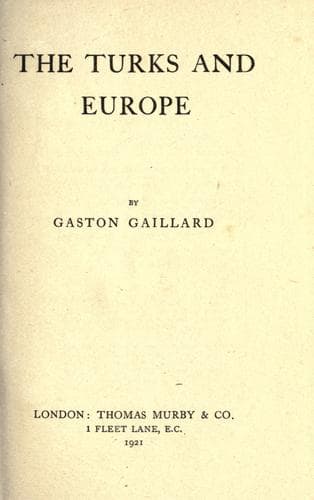
Treaty of Sèvres (1920); World War, 1914-1918 -- Territorial questions -- Turkey; World War, 1914-1918 -- Turkey
“The one cause of the downfall of the Ottoman Empire and the
extermination of its populations was the short-sighted tyranny
of the leaders of the Unionist faction—Enver, Jemal, Talaat,
and their accomplices; it is the giving up of the political
traditions established by the great Ottoman statesmen and based
on the friendship of the two Powers that deserve most to be
glorified—England and France.”
He shared the opinion of those who reproached the Turks with the
“atrocities committed by Greeks and Armenians”; he called upon them
“the reprobation of the world”; and he wound up his proclamation with
these words:
“Our hatred and enmity go to the leaders who are responsible for
such doings—Enver, Jemal, Talaat, and their accomplices. We will
not have anything to do with such tyrants, and in communion with
all believers and all unprejudiced minds in the Ottoman Empire and
Islam throughout the world we declare our hatred and enmity towards
them, and before God we separate our cause from their cause.”
Great Britain later on insisted upon this point—that the question of
the territorial conditions with a view to restoring peace had not been
dealt with since the beginning of 1916, except in the above-mentioned
exchange of notes. In September, 1919, in a semi-official communication
to the Press, she emphatically declared that it followed from these
documents:
(1) That in the letter dated October 24, 1915, which formulates the
only engagement between Great Britain and the Sherif, the British
Government had not pledged itself to do anything contrary to the
Anglo-French treaty of 1916.
(2) That no fresh engagement had been entered into by Great Britain
with the Sherif since the beginning of the negotiations that M. Georges
Picot had been directed to carry on in London to pave the way to the
treaty of 1916. For the negotiators had met for the first time on
November 23, 1915, and the last two letters exchanged in January, 1916,
added nothing to the engagements made with King Hussein in the letter
of October 24 of the previous year.
Finally, on March 5, 1917, Hussein, now King of the Hejaz, sent an
appeal to all the Moslems of Turkey against the Ottoman Government,
which he charged with profaning the tomb of the Prophet in the course
of the operations of June, 1916.
On October 1, 1918, Feisal entered Damascus at the head of his own
victorious troops, but not with the Allied armies, after fighting all
the way from Maan to Aleppo, a distance of above 400 miles. By his
military and political activity, he had succeeded in quelling the
private quarrels between tribes, and grouping round him the Arabian
chiefs, between whom there had been much rivalry not long before, at
the same time protecting the right flank of the British army, which was
in a hazardous position.
Without giving up his favourite scheme, he was thus brought face to
face with the Syrian question.
Public-domain text, read in full here on John Shaqi.
Reviews
Reviews
No reviews yet
Be the first to share your thoughts on this work.
Elsewhere in the archive
Join the Discussion
Join the discussion
Sign in to leave a comment or review.
Sign InorCreate an account