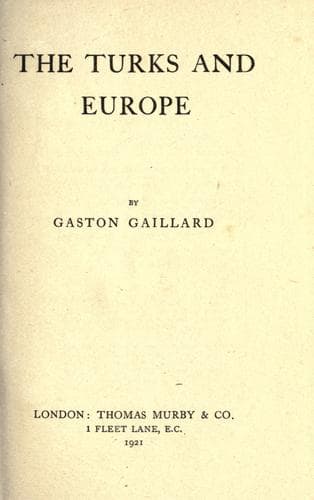
Treaty of Sèvres (1920); World War, 1914-1918 -- Territorial questions -- Turkey; World War, 1914-1918 -- Turkey
But the establishment of a Syrian State, whether enjoying the same
autonomy as Lebanon has had since 1864 under the guarantee of France,
England, Russia, Austria, Prussia, and later on Italy, or being
governed in another way, was in contradiction to the arrangements
made by France and England in 1916. Though the agreement between
these two Powers has never been made public, yet it is well known
that it had been decided—contrary to the teaching of both history and
geography—that Syria should be divided into several regions. Now, the
centre of Syria, which stretches from the Euphrates to the sea, happens
to be Damascus, and this very town, according to the British scheme,
was to be included in an Arabian Confederation headed by the Hejaz.
At the beginning of 1916, the Emir Feisal came to Paris, and, after the
conversations held in France, a satisfactory agreement seemed to have
been reached.
The Emir Feisal was solemnly received in January, 1919, at the Hôtel
de Ville in Paris, and in the course of a reception at the Hôtel
Continental, the Croix de Guerre of the first class was presented to
the Arab chief on February 4, with the following “citation”:
“As early as 1916, he resolutely seconded the efforts of his
father, the King of the Hejaz, to shake off the Turkish yoke and
support the Allied cause.
“He proved a remarkable, energetic commander, a friend to his
soldiers.
“He planned and carried out personally several important operations
against the Damascus-Medina railway, and captured El-Ouedjy and
Akaba.
“From August, 1917, till September, 1918, he led numerous attacks
north and south of Maan, capturing several railway stations and
taking a great number of prisoners.
“He helped to destroy the 4th, 7th, 8th, and 9th Turkish armies by
cutting off their communications to the north, south, and west of
Deraa, and after a very bold raid he entered Damascus on October 1,
and Aleppo on the 26th with the Allied troops.”
On February 6, 1919, he asked the Committee of the Ten on behalf of his
father, Hussein ibn Ali, to recognise the independence of the Arabian
peninsula, and declared he aimed at grouping the various regions of
Arabian Asia under one sovereignty. He did not hesitate to remind the
members of the Conference that he was speaking in the name of a people
who had already reached a high degree of civilisation at a time when
the Powers they represented did not even exist; and at the end of the
sitting in the course of which the scheme of a League of Nations was
adopted, he asked that all the secret treaties about the partition of
the Asiatic dominion of the Ottoman Empire between the Great Powers
should be definitely cancelled.
Public-domain text, read in full here on John Shaqi.
Reviews
Reviews
No reviews yet
Be the first to share your thoughts on this work.
Elsewhere in the archive
Join the Discussion
Join the discussion
Sign in to leave a comment or review.
Sign InorCreate an account