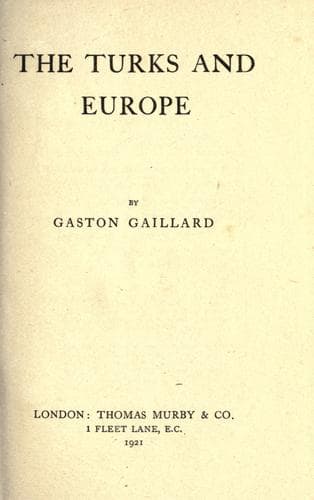
Treaty of Sèvres (1920); World War, 1914-1918 -- Territorial questions -- Turkey; World War, 1914-1918 -- Turkey
The Ishmaelites, who laid waste Persia and Syria in the eighth century,
and played an important part in the East till the twelfth century, have
also broken off with the Shia.
Lastly, the Druses, who inhabit the slopes of Lebanon and the greater
part of Anti-Lebanon between Jebeil and Saida along the Mediterranean,
profess the creed of the Caliph Al-Hakem, who lived at the beginning
of the eleventh century. They had withdrawn to Lebanon and long
repelled the attacks of the Turks, whose suzerainty they acknowledged
only in 1588. In 1842 the Porte gave them a chief, but practically
they have remained almost independent. They have often fought with the
Maronite Christians living to the north, especially in 1860, and there
is still much hostility between them.
Moreover, all Moslem communities, without exception—whether the
communities governed by independent national sovereigns such as
Afghanistan; or by sovereigns owing allegiance to non-Moslem Powers
such as Egypt, India, Tunis, Khiva, Bokhara; or the communities living
under a non-Moslem rule, as is the case with those of Algeria, Russia,
and also India and China—give their allegiance to the Sultan as Caliph,
though they are always at liberty to refuse it. Even the Moslem
communities of Algeria and Tunis, which are connected with those of
Morocco by their common origin and language, and live close by them,
do not deem it a sufficient reason to recognise the Emir of Morocco as
Caliph that he is a descendant of the Prophet.
An even more striking argument is that the community of the Hejaz,
which rebelled against Turkish sovereignty during the war and has
made itself politically independent, still maintains its religious
allegiance to the Sultan; and the present King, Hussein, who is the
most authentic descendant of the Prophet, and who rules over the two
holiest towns of Islam, Mecca and Medina, soon after the armistice
addressed the Sultan a telegram of religious allegiance drawn up
in the most deferential terms. The possession of Mecca and Medina
being one of the attributes of the Caliph, and these towns having a
great religious and political importance owing to the great annual
pilgrimage, King Hussein might have taken advantage of this to dispute
with the Sultan the title of Caliph. England had strongly urged him
to do so, but King Hussein obstinately refused. Then the British
Government, giving up all hope of bringing about the transference of
the Caliphate from the Ottoman dynasty to another sovereign, concluded
a secret alliance with Vahid ed Din.
Public-domain text, read in full here on John Shaqi.
Reviews
Reviews
No reviews yet
Be the first to share your thoughts on this work.
Elsewhere in the archive
Join the Discussion
Join the discussion
Sign in to leave a comment or review.
Sign InorCreate an account