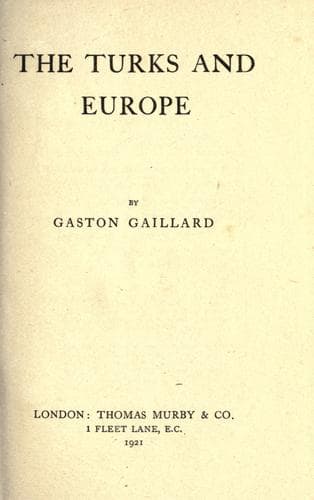
Treaty of Sèvres (1920); World War, 1914-1918 -- Territorial questions -- Turkey; World War, 1914-1918 -- Turkey
This movement, on the whole, seems chiefly to proceed—though other
factors have intervened in it—from a kind of reaction against the
standardising tendency, from a material and moral point of view, of
modern Western civilisation, especially the Anglo-Saxon civilisation,
and also from a reaction against the extreme unification aimed at by
russifying the numerous peoples living within the Russian Empire.
Modern civilisation, having reached its present climax, has aimed—and
its political and social repercussions have had the same influence—at
doing away with all differences between human minds and making the
world homogeneous; thus all men would have been brought to live in the
same way, to have the same manners, and their requirements would have
been met in the same way—to the very great advantage of its enormous
industrial development. Of course, all this proved an idle dream; human
nature soon asserted itself, amidst the commotions and perturbations
experienced by the States, and a reaction set in among those who
hitherto only aimed at enslaving various human groups, or linked them
together politically in a most artificial way. Then the same feeling
spread among all those peoples.
All this enables us to see to what extent this movement is legitimate,
and to know exactly what proportions of good and evil it contains.
It rightly asserts that various peoples have different natures, and
by protecting their freedom, it aims at ensuring the development of
their peculiar abilities. For let us not forget that the characters of
peoples depend on physical conditions, that even the features we may
not like in some peoples are due to the race, and that if, by blending
and mixing populations nowadays these features are modified, they are
generally altered only from bad to worse.
But this principle is true only so far as it frees and enables to shape
their own destinies peoples who have distinctive qualities of their
own and are able to provide for themselves. It cannot be extended—as
has been attempted in some cases—to States within which men descending
from various races or having belonged in the course of centuries to
different nationalities have long been united, and through a long
common history and a centuries-old co-operation have formed one nation.
This is one of the erroneous aspects of Mr. Wilson’s conception, and
one of the bad consequences it has entailed.
Public-domain text, read in full here on John Shaqi.
Reviews
Reviews
No reviews yet
Be the first to share your thoughts on this work.
Elsewhere in the archive
Join the Discussion
Join the discussion
Sign in to leave a comment or review.
Sign InorCreate an account