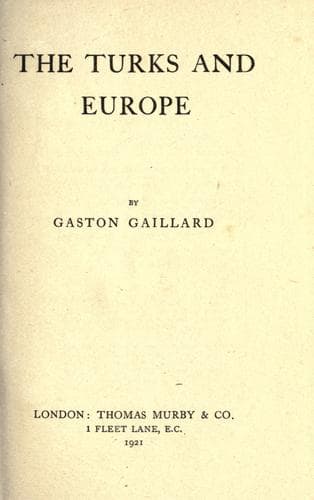
Treaty of Sèvres (1920); World War, 1914-1918 -- Territorial questions -- Turkey; World War, 1914-1918 -- Turkey
Unfortunately, French policy resorted again to the same manœuvre to
which it was indebted for its failure on the Baltic coast, and which
repeatedly deferred a solution of the Russian question. For the Allies
refused to settle the condition of the Baltic States definitely, and
even tried to restore Russia to its former state; they even urged the
Baltic States, till Yudenitch, Denikin, and Koltchak had been defeated,
to carry on the onerous struggle they had undertaken and to make all
sacrifices of men and money to capture Petrograd, which they were not
eager to do, as they would have merely paved the way to the coming of
the Pan-Russian generals.
The Allies made a similar mistake when they indirectly asked the
mountaineers of Caucasus, who wanted to be independent, to attack the
Bolshevists, but gave them no guarantee they would recognise their
independence. Of course, the mountaineers refused to play such a part,
for they risked finding themselves confronted one day or another with a
Russia that would despise their national aspirations and would oppress
them.
The situation could have been saved and the balance between the States
on the confines of the Russian Empire could have been restored only
by a close understanding of all the Caucasian peoples, after their
independence should have been recognised; the representatives of
Georgia and Azerbaïjan agreed on this point with the representatives
of Northern Caucasus, and these peoples were ready to help each other
mutually.
In the course of the last sitting of the Supreme Council to which
the delegates of Georgia and Azerbaïjan had been invited, the latter
declared “that the mountaineers were brave, that they had constituted
some of the best units of the former Russian army, and were bent upon
stopping the Bolshevists, but they lacked arms and ammunition.”
Under such circumstances it seemed the Allies could not possibly ignore
these peoples’ determination and turn a deaf ear to their earnest
request, yet they took no decision.
With regard to the Moslem question this attitude of the Conference,
which seemed bent upon ignoring Northern Caucasus, was equally
strange, for it was bound to bring about discontent among these Moslem
populations. It was the more unaccountable as the Bolshevists, who set
up as protectors of these populations, had sent many emissaries among
them, who could not but derive profit from the Allies’ attitude. The
Bolshevists had, of course, immediately recognised Daghestan a Moslem
State.
Public-domain text, read in full here on John Shaqi.
Reviews
Reviews
No reviews yet
Be the first to share your thoughts on this work.
Elsewhere in the archive
Join the Discussion
Join the discussion
Sign in to leave a comment or review.
Sign InorCreate an account