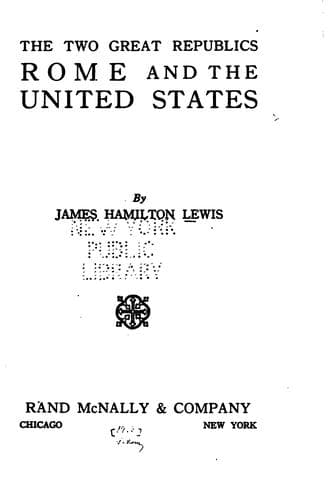
The Two Great Republics: Rome and the United StatesLewis, James
History
The Two Great Republics: Rome and the United States
Lewis, James
Rome -- Politics and government -- 510-30 B.C.; United States -- Politics and government
From a military standpoint this grant of power to Pompey was justified
by the results. Inside of three years he succeeded in completely
overthrowing both Mithridates, the old king of Pontus, Rome's most
dreaded enemy, and Tigranes, the king of Armenia. These successes of
Pompey were followed by the conquest of the greater part of Syria.
From the conquests of Pompey in the East four new Roman provinces were
formed: (1) Pontus and Bithynia; (2) Cilicia, including Isauria and
Pamphylia; (3) Syria; (4) Crete.
The demoralizing effect of these laws conferring such powers upon
Pompey were soon to manifest themselves. Rome was rapidly becoming
accustomed to the disregard of the forms of government and of law, and
to the sight of vast and irresponsible powers being granted to a
single individual. These were the two things needed to prepare Rome to
quietly acquiesce in the abandonment of the republic and the creation
of a despotism. There is never a time in any country where too great a
responsibility or power can be given to a single individual without
the greatest danger to the future of the country. The right of the
people to rule is both meaningless and valueless if such right is
merely to consist in the right to delegate all the duties and powers
of government to the custody of a single individual. A government can
continue free only where the active control of public affairs is
widely distributed, and where the masses of the people are not afraid
to accept responsibility and do not attempt to throw the
responsibility for their safety and welfare upon the shoulders of a
single individual. Where a single individual becomes indispensable to
any free people it is a sign of the degeneracy of the people rather
than of the greatness of the man.
CHAPTER X
CICERO AND CATILINE
Political honors under the Roman republic were generally to be won
only by military success, or by aggressive leadership in the factional
politics of the city. The single instance of a man's rise to a leading
place in Roman politics solely through the power of his oratory is
found in the case of Marcus Tullius Cicero. His success in the defense
of Roscius and in the prosecution of Verres, as well as his growing
reputation as a lawyer and orator, have already been referred to.
In 65 B.C. Cicero was a successful candidate for the consulship. His
letters written to his friend Atticus at Athens, during his campaign,
give a most vivid insight into the practical Roman politics of the
times, and show us the striking similarity, in many respects, between
the political battles of the Roman republic and our own election
contests.
In one of his early letters Cicero wrote: "Let me tell you that there
is no class of people so harassed by every kind of unreasonable
difficulty as candidates for office."
In a later letter he discusses the details of his campaign as follows:
Public-domain text, read in full here on John Shaqi.
Reviews
Reviews
No reviews yet
Be the first to share your thoughts on this work.
Elsewhere in the archive
Join the Discussion
Join the discussion
Sign in to leave a comment or review.
Sign InorCreate an account