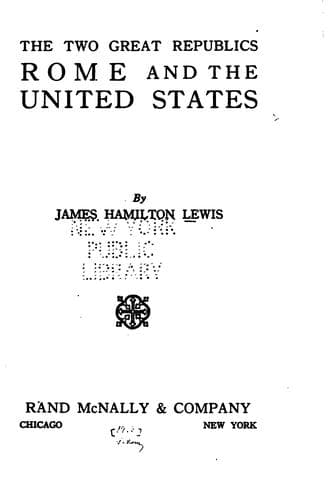
The Two Great Republics: Rome and the United StatesLewis, James
History
The Two Great Republics: Rome and the United States
Lewis, James
Rome -- Politics and government -- 510-30 B.C.; United States -- Politics and government
The year of Cicero's consulship (64 B.C.) was disturbed by the famous
conspiracy of Lucius Sergius Catiline. It was in this conspiracy, and
during this consulship, that the culmination was reached of the
discontent and plotting which had been fermenting at Rome for a
number of years among a large class of the Roman nobility. The most
discontented men in any community are generally to be found among
those who, while belonging by birth to the upper classes of society,
and accustomed to and desirous of the luxuries of life, have lost
their fortunes and are unable to live in the style to which they
consider themselves as of right entitled. Rome, at this time, was
filled with this class of malcontents, the extravagant and wasteful
style of living, combined with the reckless gambling of the age,
having reduced great numbers among the young nobles almost to beggary.
The overthrow of Sulla's system of government, resulting from the
defection of Pompey and the consequential loss of power and prestige
by the Senate, had also roused a bitter feeling of resentment among
the whole aristocratic party. The effect of this resentment upon the
more solid and substantial element of this party had been to lead them
to make preparations for the overthrow of Pompey upon his return to
Rome; while the effect upon the ruined young nobles was to render
them more than ever ready for any desperate undertaking by which they
stood a chance of repairing their fortunes.
No cause, whether good or bad, ever lacks a leader; and the leader at
this time was found in Catiline, a young noble of the most profligate
character, but of some degree of ability and possessed of boundless
audacity and ambition.
Catiline was descended from one of the oldest families in Rome, and
his loyalty to the cause of the aristocracy was proved by the ferocity
with which he had served under Sulla and had assisted in carrying into
execution his most bloodthirsty orders. Catiline did not fail to
derive some profit from these terrible times, as he secured the
proscription and murder of his brother and the grant to himself of his
brother's forfeited estate.
Public-domain text, read in full here on John Shaqi.
Reviews
Reviews
No reviews yet
Be the first to share your thoughts on this work.
Elsewhere in the archive
Join the Discussion
Join the discussion
Sign in to leave a comment or review.
Sign InorCreate an account