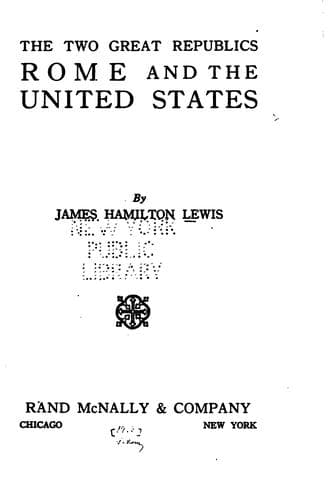
The Two Great Republics: Rome and the United StatesLewis, James
History
The Two Great Republics: Rome and the United States
Lewis, James
Rome -- Politics and government -- 510-30 B.C.; United States -- Politics and government
Cæsar's Spanish campaign had been so short in duration that he was
enabled to return to Rome in time to run for the consulship in 60 B.C.
In order to begin his canvass without delay, Cæsar asked leave to
enter the city before receiving his triumph. This permission being
refused, mainly through the influence of Cato and Cicero, Cæsar gave
up his claim to a triumph and, entering Rome immediately, began his
political campaign. Being again hard up for money, Cæsar made an
agreement with a very wealthy candidate for consul, named L. Lucceius,
by the terms of which Lucceius was to provide the campaign funds for
both candidates, while Cæsar was to furnish the reputation and
popularity. This combination resulted better for Cæsar than for
Lucceius; Cæsar received his share of the benefit from the campaign
fund, but the benefit of his popularity did not seem to extend to his
running mate. The election resulted in the choice of Cæsar and M.
Calpurnius Bibulus, the candidate of the Cato-Cicero faction.
At this time Cæsar persuaded Pompey and Crassus to form the first
triumvirate with him. This triumvirate was nothing more nor less than
a Roman political machine, by means of which these three men expected
to be able to make themselves the political bosses of the city. To
cement this political union, Pompey married Julia, the daughter of
Cæsar.
The most important event of Cæsar's consulship was the passage of an
agrarian act providing for the division of public lands in Campania
among the old soldiers of Pompey. The members of the triumvirate
proved themselves to be strong enough to force this measure through in
spite of the opposition of the consul Bibulus, of Cato, and of others.
The measure was not passed, however, without considerable violence and
disregard of the technical rules of the Roman law.
The Senate, acting under the authority of the Sempronian Law, had
assigned the woods and roads as the provinces to which the consuls of
the year were to be assigned after the expiration of their terms of
office. Cæsar, however, who throughout his career never bothered
himself very much as to what the law was, secured the passage by the
comitia tributa of a law introduced by the tribune Vatinius, which
gave to Cæsar the provinces of Cisalpine Gaul and Illyricum and three
legions for five years. Later the Senate (to prevent another appeal by
Cæsar to the people) added Transalpine Gaul and another legion to his
command. The time of his command was also later extended.
It was the success of Cæsar's Gallic campaigns (58-51 B.C.) which
rendered possible his overthrow of the republic, and the importance of
this war is therefore very great, but it is unnecessary to deal with
the military details of these campaigns.
Public-domain text, read in full here on John Shaqi.
Reviews
Reviews
No reviews yet
Be the first to share your thoughts on this work.
Elsewhere in the archive
Join the Discussion
Join the discussion
Sign in to leave a comment or review.
Sign InorCreate an account