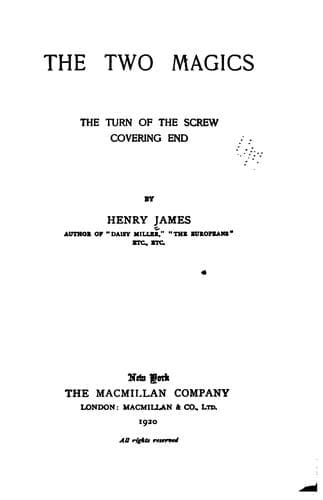
The Two Magics: The Turn of the Screw, Covering EndJames, Henry
General
The Two Magics: The Turn of the Screw, Covering End
James, Henry
Children -- Fiction; Country homes -- Fiction; Courtship -- Fiction; England -- Fiction; Governesses -- Fiction; Mortgages -- Fiction
“And, naturally, in person,” Mr. Prodmore intelligently assented,
“do yourself, as well as the young lady, justice. Do you remember
what you said when I first, in London, laid the matter before you?”
Clement Yule did remember, but his amusement increased. “I think
I said it struck me I should first take a look at--what do you call
it?--the _corpus delicti_.”
“You should first see for yourself what you had really come into? I
was not only eager for that,” said Mr. Prodmore, “but I’m willing
to go further: I’m quite ready to hear you say that you think you
should also first see the young lady.”
Captain Yule continued to laugh. “There is something in that then,
since you mention it!”
“I think you’ll find that there’s everything.” Mr. Prodmore
again looked at his watch. “Which will you take first?”
“First?”
“The young lady or the house?”
His companion, at this, unmistakeably started. “Do you mean your
daughter’s _here_?”
Mr. Prodmore glowed with consciousness. “In the morning-room.”
“Waiting for me?”
The tone showed a consternation that Mr. Prodmore’s was alert to
soothe. “Ah, as long, you know, as you like!”
Yule’s alarm, however, was not assuaged; it appeared to grow as he
stared, much discomposed, yet sharply thinking, at the door to which
his friend had pointed. “Oh, longer than _this_, please!” Then as
he turned away: “Do you mean she knows----?”
“That she’s here on view?” Mr. Prodmore hung fire a moment, but
was equal to the occasion. “She knows nothing whatever. She’s as
unconscious as the rose on its stem!”
His companion was visibly relieved. “That’s right--let her remain
so! I’ll first take the house,” said Clement Yule.
“Shall I go round _with_ you?” Mr. Prodmore asked.
The young man’s reflection was brief. “Thank you. I’d rather, on
the whole, go round alone.”
The old servant who had admitted the gentlemen came back at this crisis
from the morning-room, looking from under a bent brow and with much
limpid earnestness from one of them to the other. The one he first
addressed had evidently, though quite unaware of it, inspired him with
a sympathy from which he now took a hint. “There’s tea on, sir!”
he persuasively jerked as he passed the younger man.
The elder answered. “Then I’ll join my daughter.” He gained
the morning-room door, whence he repeated with an appropriate
gesture--that of offering proudly, with light, firm fingers, a flower
of his own celebrated raising--his happy formula of Miss Prodmore’s
state. “The rose on its stem!” Scattering petals, diffusing
fragrance, he thus passed out.
Chivers, meanwhile, had rather pointlessly settled once more in its
place some small object that had not strayed; to whom Clement Yule,
absently watching him, abruptly broke out. “I say, my friend, what
colour is the rose?”
The old man looked up with a dimness that presently glimmered. “The
rose, sir?” He turned to the open door and the shining day. “Rather
a brilliant----”
“A brilliant----?” Yule was interested.
Public-domain text, read in full here on John Shaqi.
Reviews
Reviews
No reviews yet
Be the first to share your thoughts on this work.
Elsewhere in the archive
Join the Discussion
Join the discussion
Sign in to leave a comment or review.
Sign InorCreate an account