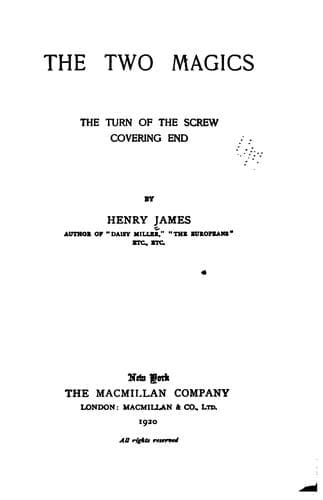
The Two Magics: The Turn of the Screw, Covering EndJames, Henry
General
The Two Magics: The Turn of the Screw, Covering End
James, Henry
Children -- Fiction; Country homes -- Fiction; Courtship -- Fiction; England -- Fiction; Governesses -- Fiction; Mortgages -- Fiction
He took up the piece with tenderness, though, in his general agitation,
not perhaps with all the caution with which, for daily service, he
handled ancient frailties. He at any rate turned on this fresh subject
an interested, puzzled eye. “Where is it I’ve known this very
bit--though not to say, as _you_ do, by name?” Suddenly it came to
him. “In the pew-opener’s front parlour!”
“No,” his interlocutress cried, “in the pew-opener’s best
bedroom: on the old chest of drawers, you know--with those ducks of
brass handles. I’ve got the handles too--I mean the whole thing;
and the brass fender and fire-irons, and the chair her grandmother died
in. Not in the fly,” she added--“it was such a bore that they have
to be sent.”
Chivers, with the pot still in his hands, fairly rocked in the high
wind of so much confidence and such great transactions. He had nothing
for these, however, but approval. “You did right to take this out,
mum, when the fly went to the stables. Them flymen do be cruel rash
with anything that’s delicate.” Of the delicacy of the vessel
it now rested with him to deposit safely again he was by this time
so appreciatively aware that in returning with it to its safe niche
he stumbled into some obscure trap literally laid for him by his
nervousness. It was the matter of a few seconds, of a false movement,
a knock of the elbow, a gasp, a shriek, a complete little crash. There
was the pot on the pavement, in several pieces, and the clumsy
cup-bearer blue with fear. “Mercy _on_ us, mum,--I’ve brought shame
on my old grey hairs!”
The little shriek of his companion had smothered itself in the
utterance, and the next minute, with the ruin between them, they
were contrastedly face to face. The charming woman, who had already
found more voices in the air than anyone had found before, could, in
the happy play of this power, find a poetry in her accident. “Oh,
but the way you _take_ it!” she laughed--“you’re too quaint
to live!” She looked at him as if he alone had suffered--as if his
suffering indeed positively added to his charm. “The way you said
that now--it’s just the very ‘type’! That’s all I want of
you now--to _be_ the very type. It’s what you are, you poor dear
thing--for you _can’t_ help it; and it’s what everything and
everyone else is, over here; so that you had just better all make
up your minds to it and not try to shirk it. There was a type in the
train with me--the ‘awfully nice girl’ of all the English novels,
the ‘simple maiden in her flower’ of--who is it?--your great
poet. _She_ couldn’t help it either--in fact I wouldn’t have _let_
her!” With this, while Chivers picked up his fragments, his lady had
a happy recall. His face, as he stood there with the shapeless elements
of his humiliation fairly rattling again in his hands, was a reflection
of her extraordinary manner of enlarging the subject, or rather, more
beneficently perhaps, the space that contained it. “By the way, the
girl was coming right here. Has she come?”
Public-domain text, read in full here on John Shaqi.
Reviews
Reviews
No reviews yet
Be the first to share your thoughts on this work.
Elsewhere in the archive
Join the Discussion
Join the discussion
Sign in to leave a comment or review.
Sign InorCreate an account