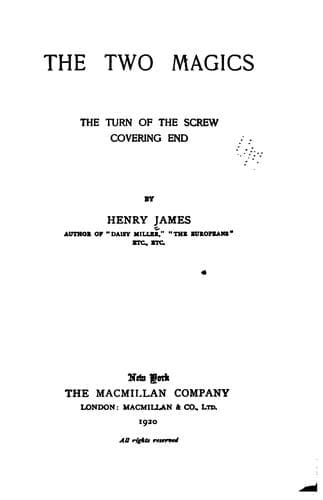
The Two Magics: The Turn of the Screw, Covering EndJames, Henry
General
The Two Magics: The Turn of the Screw, Covering End
James, Henry
Children -- Fiction; Country homes -- Fiction; Courtship -- Fiction; England -- Fiction; Governesses -- Fiction; Mortgages -- Fiction
It was apparently a result of what had passed in the morning-room that
Mr. Prodmore had grasped afresh the need for effective action, which
he clearly felt he did something to meet in clutching precipitately the
helping hand popped so suddenly out of space, yet so beautifully gloved
and so pressingly and gracefully brandished. “So fresh, so quaint, so
droll!”--he again gave Captain Yule the advantage of the stranger’s
impression.
To what further appreciation this might have prompted the lady herself
was not, however, just then manifest; for the return of Chivers had
been almost simultaneous with the advance of the Prodmores, and it had
taken place with forms that made it something of a circumstance. There
was positive pomp in the way he preceded several persons of both sexes,
not tourists at large, but simple sightseers of the half-holiday order,
plain provincial folk already, on the spot, rather awestruck. The old
man, with suppressed pulls and prayers, had drawn them up in a broken
line, and the habit of more peopled years, the dull drone of the dead
lesson, sounded out in his prompt beginning. The party stood close,
in this manner, on one side of the apartment, while the master of the
house and his little circle were grouped on the other. But as Chivers,
guiding his squad, reached the centre of the space, Mrs. Gracedew,
markedly moved, quite unreservedly engaged, came slowly forward to
meet him. “This, ladies and gentlemen,” he mechanically quavered,
“is perhaps the most important feature--the grand old feudal,
baronial ’all. Being, from all accounts, the most ancient portion of
the edifice, it was erected in the very earliest ages.” He paused a
moment, to mark his effect, then gave a little cough which had become,
obviously, in these great reaches of time, an essential part of the
trick. “Some do say,” he dispassionately remarked, “in the course
of the fifteenth century.”
Mrs. Gracedew, who had visibly thrown herself into the working of the
charm, following him with vivid sympathy and hanging on his lips, took
the liberty, at this, of quite affectionately pouncing on him. “_I_
say in the fourteenth, my dear--you’re robbing us of a hundred
years!”
Her victim yielded without a struggle. “I do seem, in them dark
old centuries, sometimes to trip a little.” Yet the interruption of
his ancient order distinctly discomposed him, all the more that his
audience, gaping with a sense of the importance of the fine point,
moved in its mass a little nearer. Thus put upon his honour, he
endeavoured to address the group with a dignity undiminished. “The
Gothic roof is much admired, but the west gallery is a modern
addition.”
Public-domain text, read in full here on John Shaqi.
Reviews
Reviews
No reviews yet
Be the first to share your thoughts on this work.
Elsewhere in the archive
Join the Discussion
Join the discussion
Sign in to leave a comment or review.
Sign InorCreate an account