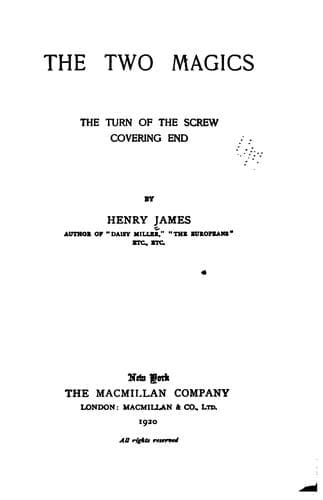
The Two Magics: The Turn of the Screw, Covering EndJames, Henry
General
The Two Magics: The Turn of the Screw, Covering End
James, Henry
Children -- Fiction; Country homes -- Fiction; Courtship -- Fiction; England -- Fiction; Governesses -- Fiction; Mortgages -- Fiction
He had such an air of proposing a bargain, of making the wait a
condition, that she had to look it well in the face. The result of
her doing so, however, was apparently a strong sense that she could
give him no pledge. Her silence, after a moment, expressed that; but,
for a further emphasis, moving away, she sank suddenly into the chair
she had already occupied and in which, serious again and very upright,
she continued to withhold her promise. “Go up to him!” she simply
repeated. He obeyed, with an abrupt turn, mounting briskly enough
several steps, but pausing midway and looking back at her as if he were
after all irresolute. He was in fact so much so that, at the sight of
her still in her chair and alone by his cold hearth, he descended a
few steps again and seemed, with too much decidedly on his mind, on the
point of breaking out. She had sat a minute in such thought, figuring
him clearly as gone, that at the sound of his return she sprang up
with a protest. This checked him afresh, and he remained where he had
paused, still on the ascent and exchanging with her a look to which
neither party was inspired, oddly enough, to contribute a word. It
struck him, without words, at all events, as enough, and he now took
his upward course at such a pace that he presently disappeared. She
listened awhile to his retreating tread; then her own, on the old flags
of the hall, became rapid, though, it may perhaps be added, directed
to no visible end. It conveyed her, in the great space, from point to
point, but she now for the first time moved there without attention and
without joy, her course determined by a series of such inward throbs as
might have been the suppressed beats of a speech. A real observer, had
such a monster been present, would have followed this tacit evolution
from sign to sign and from shade to shade. “Why didn’t he tell me
_all_?--But it was none of my business!--What does he mean to do?--What
should he do but what he _has_ done?--And what _can_ he do, when he’s
so deeply committed, when he’s practically engaged, when he’s just
the same as married--and buried?--The thing for _me_ to ‘do’ is
just to pull up short and bundle out: to remove from the scene they
encumber the numerous fragments--well, of what?”
Her thought was plainly arrested by the sight of Cora Prodmore, who,
returning from the garden, reappeared first in the court and then in
the open doorway. Mrs. Gracedew’s was a thought, however, that, even
when desperate, was never quite vanquished, and it found a presentable
public solution in the pieces of the vase smashed by Chivers and just
then, on the table where he had laid them, catching her eye. “Of
my old Chelsea pot!” Her gay, sad headshake as she took one of them
up pronounced for Cora’s benefit its funeral oration. She laid the
morsel thoughtfully down, while her visitor seemed with simple dismay
to read the story.
VI
“Has he been _breaking_----?” the girl asked in horror.
Public-domain text, read in full here on John Shaqi.
Reviews
Reviews
No reviews yet
Be the first to share your thoughts on this work.
Elsewhere in the archive
Join the Discussion
Join the discussion
Sign in to leave a comment or review.
Sign InorCreate an account