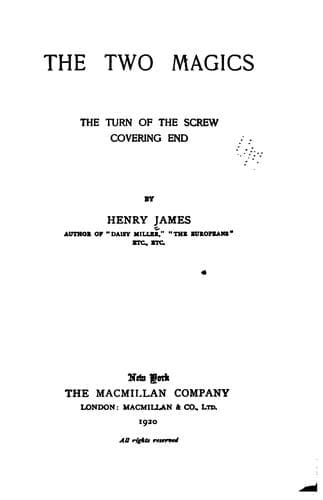
The Two Magics: The Turn of the Screw, Covering EndJames, Henry
General
The Two Magics: The Turn of the Screw, Covering End
James, Henry
Children -- Fiction; Country homes -- Fiction; Courtship -- Fiction; England -- Fiction; Governesses -- Fiction; Mortgages -- Fiction
His reappearance interrupts and yet in a manner, after all, quickens
our intense impression; Chivers on the spot, and in this severe but
spacious setting, was so perfect an image of immemorial domesticity. It
would have been impossible perhaps, however, either to tell his age
or to name his use: he was of the age of all the history that lurked
in all the corners and of any use whatever you might be so good as
still to find for him. Considerably shrunken and completely silvered,
he had perpetual agreement in the droop of his kind white head and
perpetual inquiry in the jerk of the idle old hands now almost covered
by the sleeves of the black dress-coat which, twenty years before,
must have been by a century or two the newest thing in the house and
into which his years appeared to have declined very much as a shrunken
family moves into a part of its habitation. This attire was completed
by a white necktie that, in honour of the day, he himself had this
morning done up. The humility he betrayed and the oddity he concealed
were alike brought out by his juxtaposition with the gentleman he had
admitted.
To admit Mr. Prodmore was anywhere and at any time, as you would
immediately have recognised, an immense admission. He was a personage
of great presence and weight, with a large smooth face in which
a small sharp meaning was planted like a single pin in the tight
red toilet-cushion of a guest-chamber. He wore a blue frock-coat
and a stiff white waistcoat and a high white hat that he kept on
his head with a kind of protesting cock, while in his buttonhole
nestled a bold prize plant on which he occasionally lowered a
proprietary eye that seemed to remind it of its being born to a public
career. Mr. Prodmore’s appearance had evidently been thought out,
but it might have struck you that the old portraits took it in with
a sterner stare, with a fixedness indeed in which a visitor more
sensitive would have read a consciousness of his remaining, in their
presence, so jauntily, so vulgarly covered. He had never a glance for
them, and it would have been easy after a minute to see that this was
an old story between them. Their manner, as it were, sensibly increased
the coolness. This coolness became a high rigour as Mr. Prodmore
encountered, from the very threshold, a disappointment.
“No one here?” he indignantly demanded.
“I’m sorry to say no one has come, sir,” Chivers replied; “but
I’ve had a telegram from Captain Yule.”
Mr. Prodmore’s apprehension flared out. “Not to say he ain’t
coming?”
“He was to take the 2.20 from Paddington; he certainly _should_
be here!” The old man spoke as if his non-arrival were the most
unaccountable thing in the world, especially for a poor person ever
respectful of the mystery of causes.
“He should have been here this hour or more. And so should my
fly-away daughter!”
Public-domain text, read in full here on John Shaqi.
Reviews
Reviews
No reviews yet
Be the first to share your thoughts on this work.
Elsewhere in the archive
Join the Discussion
Join the discussion
Sign in to leave a comment or review.
Sign InorCreate an account