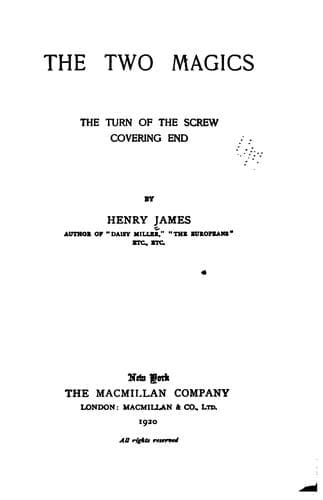
The Two Magics: The Turn of the Screw, Covering EndJames, Henry
General
The Two Magics: The Turn of the Screw, Covering End
James, Henry
Children -- Fiction; Country homes -- Fiction; Courtship -- Fiction; England -- Fiction; Governesses -- Fiction; Mortgages -- Fiction
“In everything,” Mr. Prodmore distinctly informed him, “that’s
wrong! But here he is!” that gentleman added with elation as
the doorbell again sounded. Chivers, under the double agitation of
the appeal and the disclosure, proceeded to the front as fast as
circumstances allowed; while Mr. Prodmore, left alone, would have
been observed--had not his solitude been so bleak--to recover a
degree of cheerfulness. Cheerfulness in solitude at Covering End was
certainly not irresistible, but particular feelings and reasons had
pitched, for their campaign, the starched, if now somewhat ruffled,
tent of his large white waistcoat. If they had issued audibly from
that pavilion, they would have represented to us his consciousness
of the reinforcement he might bring up for attack should Captain
Yule really resist the house. The sound he next heard from the front
caused him none the less, for that matter, to articulate a certain
drop. “Only Cora?--Well,” he added in a tone somewhat at variance
with his “only,” “he shan’t, at any rate, resist _her_!”
This announcement would have quickened a spectator’s interest in
the young lady whom Chivers now introduced and followed, a young
lady who straightway found herself the subject of traditionary
discipline. “I’ve waited. What do you mean?”
Cora Prodmore, who had a great deal of colour in her cheeks and a great
deal more--a bold variety of kinds--in the extremely high pitch of
her new, smart clothes, meant, on the whole, it was easy to see, very
little, and met this challenge with still less show of support either
from the sources I have mentioned or from any others. A dull, fresh,
honest, overdressed damsel of two-and-twenty, she was too much out
of breath, too much flurried and frightened, to do more than stammer:
“Waited, papa? Oh, I’m sorry!”
Her regret appeared to strike her father still more as an impertinence
than as a vanity. “Would you then, if I had not had patience for you,
have wished not to find me? Why the dickens are you so late?”
Agitated, embarrassed, the girl was at a loss. “I’ll tell you,
papa!” But she followed up her pledge with an air of vacuity and
then, dropping into the nearest seat, simply closed her eyes to her
danger. If she desired relief, she had caught at the one way to get
it. “I feel rather faint. Could I have some tea?”
Mr. Prodmore considered both the idea and his daughter’s substantial
form. “Well, as I shall expect you to put forth _all_ your
powers--yes!” He turned to Chivers. “Some tea.”
The old man’s eyes had attached themselves to Miss Prodmore’s
symptoms with more solicitude than those of her parent. “I did
think it might be required!” Then as he gained the door of the
morning-room: “I’ll lay it out here.”
The young lady, on his withdrawal, recovered herself sufficiently to
rise again. “It was my train, papa--so very awfully behind. I walked
up, you know, also, from the station--there’s such a lovely footpath
across the park.”
Public-domain text, read in full here on John Shaqi.
Reviews
Reviews
No reviews yet
Be the first to share your thoughts on this work.
Elsewhere in the archive
Join the Discussion
Join the discussion
Sign in to leave a comment or review.
Sign InorCreate an account