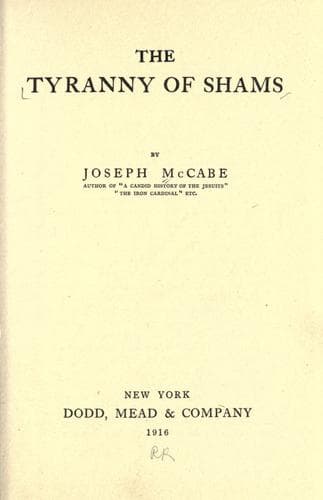
Great Britain -- Social conditions; Moral conditions; Social problems
But the misrepresentation of Roman morals is light in comparison with
the misrepresentation of later Christian morals. Christianity took its
ideal from the Jews. Amongst this partially civilised people marriage
had been made easy for the male by the retention of polygamy, and it
was not customary to consult the feelings of the woman. In the course
of time Greek influence entered Judæa, and the Rabbis held learned
debates on marriage and divorce. Both the stricter and the laxer view
found expression in the New Testament and in early Christian
literature, but a celibate priesthood obtained supreme power in Europe
and the stricter view was enforced. The moral consequences were
disastrous. While the Roman _Curia_, which could always find a flaw in
the marriage of a wealthy man, was enriched, Europe was degraded, and
sexual immorality became general. It is enough to recall that a
tradition of looseness, in strict correspondence with the law of
indissoluble marriage, survives from the ages of faith to our own time
in the Latin countries. Some have spoken of "the hot southern
blood" and cast the blame on the climate. I would invite the
informed moralist to run his eye over the map of the earth, and ask
himself whether chastity increases, or the sex-organs lose vitality,
in proportion as nations are removed from the Equator. It is a
ludicrous effort of Catholics to conceal the evils of indissoluble
marriage. Until the Reformation sexual laxity was the same all over
Europe.
In England the old priest-made law was retained after the Reformation,
and laxity of morals was general. Except for a very few wealthy
people, divorce was impossible until 1857, when a slender measure of
reform was wrested from the clergy. This, the present law of England,
a miserable compromise with religious prejudice and a permanent source
of vice and misery, puts English legislation on an important aspect of
"the foundation of the State" below that of any other civilised
community. Instead of ridding themselves entirely of clerical
influence, and directing civic life on civic grounds, our legislators
looked still to ancient Judæa, and substituted the less stringent
view of the Rabbis for the more stringent. The legendary leader of a
rude Arab tribe had granted divorce for adultery, and the English
nation of the nineteenth century followed his example. The result was
the most stupid and mischievous law of marriage outside the sphere of
the Holy Catholic Church.
Public-domain text, read in full here on John Shaqi.
Reviews
Reviews
No reviews yet
Be the first to share your thoughts on this work.
Elsewhere in the archive
Join the Discussion
Join the discussion
Sign in to leave a comment or review.
Sign InorCreate an account