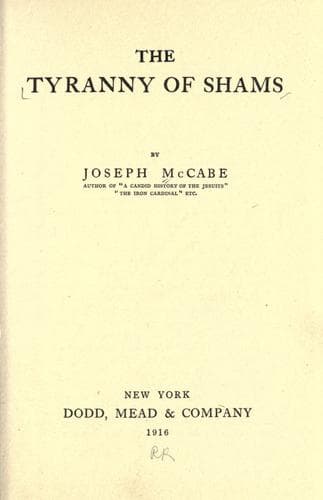
Great Britain -- Social conditions; Moral conditions; Social problems
Some explain that they fear "the thin edge of the wedge." As if
wedges had a way of pressing deeper by their own weight, once we have
admitted them! If England chooses to grant these reforms, and no
others, she need not be deterred by empty phrases. But I believe that
the alert and resolute race which is coming will go much further than
this. Before many generations, if not in ours, there will be divorce
for incompatibility of temperament in every civilised country. Men and
women will be divorced, after due delay, because they wish, or when
one of them can show grave cause to separate from the other.
Ill-informed people express a concern about the children or the social
consequences. They do not take the trouble to inquire what happens in
some of the American States, or in Denmark, Norway, Sweden, and
Switzerland, where there is long and ample experience of divorce by
mutual consent. The social consequences are just what any unprejudiced
person would expect: happier homes, and more healthily engendered and
reared children. But the puritan does not want to inquire: he is not
sincere. Would he agree to divorce by mutual consent where there are
no children or where either or both parents make adequate provision
for them? He would not. I will, however, return later to the question
of children.
Europe will be far happier when some such humane law as the Danish is
generally adopted, and, after a few years' separation, the
discontented are free to remarry. But no one who is acquainted with
the tendency and influence of modern literature can fancy that this
will be the last state of the old ideal of the family. From the first
years when men were free to declare their opinions without fear of the
stake, writers of great power have claimed the right of what has come
to be called "free love." Some would abolish marriage, but the
normal shape of the demand is that men and women shall be free to love
and beget children whether or no they ask the blessing of Church or
State. By the latter part of the eighteenth century, when Goethe took
a concubine on the pagan model, many of the first literary men in
Europe pressed this demand, and it is sustained by some of the most
brilliant writers in every country to-day. The movement exhibits the
slow and steady growth characteristic of reforms which eventually
triumph. It is no mere bubble on the surface of our effervescent life;
it is the new intelligence of the race examining the old traditions.
Public-domain text, read in full here on John Shaqi.
Reviews
Reviews
No reviews yet
Be the first to share your thoughts on this work.
Elsewhere in the archive
Join the Discussion
Join the discussion
Sign in to leave a comment or review.
Sign InorCreate an account