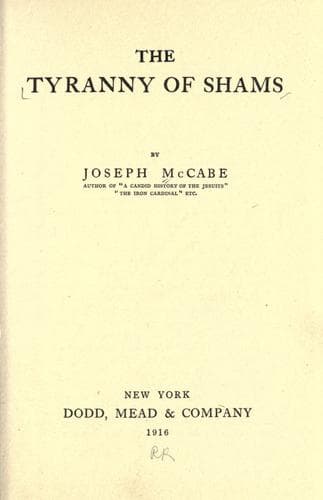
Great Britain -- Social conditions; Moral conditions; Social problems
In the case of negative Eugenics we are nearer agreement. Here again,
however, research is not always candid. Inquiries have been made into
the lineage of American criminals, and the large percentage of
criminals in one family is held to indicate a tainted stock: it is not
sufficiently noticed that they all lived in the same crime-breeding
environment. Other Eugenists try to intimidate us with the cry that
lunacy and crime are increasing rapidly: whereas (as I showed in the
_Hibbert Journal_, April 1912) there is no proved increase of lunacy
and no increase of crime, in proportion to the growth of population.
These methods bring discredit on the Eugenic proposals. It is,
however, now agreed that certain diseases, including certain forms of
mental disease, are transmissible, and common-sense suggests that we
should prevent their transmission. It is well to bear in mind,
however, that these things affect only a fraction of the community. As
is the case with every new social proposal, Eugenics is being pressed
as a panacea; and it appeals to many as a fascinating method of
healing our social maladies without touching the present distribution
of wealth. It is one subsidiary remedy among the hundred which modern
civilisation needs to apply. By all means let us discover what
"tainted stocks," if any, there are amongst us; and let us have
the elementary courage and intelligence to extinguish them, by the
isolation, painless destruction, or sterilisation of their
representatives.
The future of the family seems not obscure. Malthusian and Eugenic
proposals will alter much of the crudeness and stupidity of the old
family ideal, and ease of divorce will remove the blight it has put on
many a home. Hundreds of thousands bless marriage with gratitude and
sincerity: tens of thousands curse it with equal sincerity. Let there
be liberty and life for all. For a modern legislature to ignore a vast
amount of vice and misery, and be guided by the ancient formula of a
celibate priesthood, is one of the most lamentable features of our
civilisation. And the unbiased social student may look without concern
on the growth of extra-matrimonial love. There is no interest of the
State which forbids it, nor any sound principle of morals. The woman
of the future will be her own mistress, responsible neither to priest
nor moralist in this respect. If she chooses, she will marry; but she
will not sacrifice half the joy of life because she cannot, or does
not choose to, venture upon the experiment of domestic intimacy.
CHAPTER VII.
THE FUTURE OF WOMAN
Public-domain text, read in full here on John Shaqi.
Reviews
Reviews
No reviews yet
Be the first to share your thoughts on this work.
Elsewhere in the archive
Join the Discussion
Join the discussion
Sign in to leave a comment or review.
Sign InorCreate an account