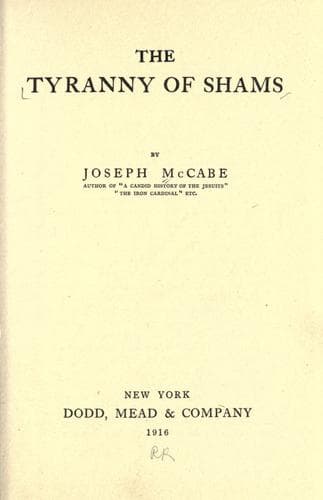
Great Britain -- Social conditions; Moral conditions; Social problems
The education authority of the Metropolis of England would, one
supposes, have the advantage of the finest expert advice in the world.
Enter one of the thousands of schools under its control, however, and
ask how the training of character is conducted. A teacher informs you
that at college he has learned only to impart "Biblical
knowledge." He will show you a scheme of lessons founded on the Old
and New Testament. The younger the child, the more preposterous the
lesson. In the lower standards the child must learn the story of the
Creation, the Fall, the Deluge, etc. It is still too young to imagine
that its teacher may, at the command of our education authorities, be
grossly deceiving it, or to perceive that these ancient Babylonian
legends contain no particular incentive to virtue. When it passes to
the higher standards it is initiated to some equally remarkable
stories about the early history of mankind and the early conduct of
the Deity. The teacher rarely believes these things, and it may be
assumed that men like Mr. Sidney Webb, who voted for this scheme of
education in the L.C.C., do not. If the child has intelligence enough
to raise the question of veracity, it must be snubbed or deceived. A
London teacher told me that on one occasion, when he had described
some of the remarkable proceedings of the Israelites in ancient
Palestine, a precocious youngster asked: "Please, sir, is it
true?" Our education authorities forbid him to reply to such a
question. Indeed, his headmaster was a Nonconformist (very zealous for
Bible lessons), and would find a way to punish any departure from the
appointed untruths.
The lessons from the New Testament are, it is true, devoid of this
atmosphere of Oriental animalism, ferocity, and superstition which
clings to the Old Testament lesson, but here again the teacher is
forced to violate the elementary principles of education. He must
gravely tell the story of the miraculous birth, the crucifixion, and
the resurrection of Christ. He probably knows that some of the most
learned divines in England and other countries regard these stories as
false, but he must deliberately and solemnly tell the young that
Christ was God and that these things are written in the "Word of
God." He must repeat parables which we know to have been borrowed
(and often spoiled in the borrowing) from the Jewish rabbis, yet teach
that this was the unique feature of Christ's preaching. He must use
all his ingenuity to wring a moral lesson out of the parables of the
workers in the vineyard, the royal banquet, and so on. He must keep up
this elaborate deception of the child until it leaves his care; and he
knows that, in nine cases out of ten in London or any large city, the
child is already hearing on all sides sneers at these ancient myths,
and laughing at the system which inculcates them in the name of all
that is most sacred.
Public-domain text, read in full here on John Shaqi.
Reviews
Reviews
No reviews yet
Be the first to share your thoughts on this work.
Elsewhere in the archive
Join the Discussion
Join the discussion
Sign in to leave a comment or review.
Sign InorCreate an account