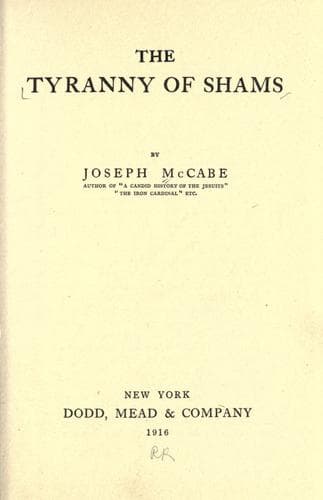
Great Britain -- Social conditions; Moral conditions; Social problems
It is represented that we are in danger of a triumph of
"materialism," and it is therefore wise to cling, in spite of
their errors, to the Churches which so solidly represent
"spiritualism." Since many people have regarded me as peculiarly
exposed to this danger of falling under the evil spell of
"materialism," I have made eager inquiries among spiritualist
writers as to the nature of "spirit." I am still hopefully
inquiring. Most of the anæmic mystics who gush over the word cannot
tell you what it means. They have a vague conviction that the
spiritual is immensely more important and productive of good than the
material, and that therefore materialism is the most appalling blight
that can fall on a nation. These prophets of evil are, as I have
previously observed, not strong in history. They do not explain how
Confucianism (which Sir Edwin Arnold, accurately enough, calls
materialism) proved so great an inspiration in China and Japan: how
the Stoics (who refused utterly to believe in spirit) wrought so much
good and inspired so fine a character at Rome: or how this
materialistic age of ours is so idealistic. They know only that we
must at all costs cultivate the spiritual--read spiritual writers,
respect spiritual persons, encourage spiritual clergymen and artists
and actors--and loathe materialism from the bottom of our hearts. And
it is therefore quite natural to suppose that all that is precious in
life and progress depends on the belief in the existence of
"spirits."
In point of fact, we have here entangled ourselves in an extraordinary
confusion. The cultivation of intelligence, fine sentiment, and
straight character has nothing whatever to do with the question
whether the mind of man is or is not divisible into parts, or has or
has not "inertia": which are the only philosophic distinctions
between matter and spirit that I have discovered. The tradition of the
spirituality of the mind is responsible for this confusion. _If_ the
mind is a spirit, then spirit is assuredly the source of the finest
things in life, and is far superior to matter. But that is just the
question at issue; and it really does not matter two pins for
practical purposes whether the mind is extended and inert (in the
scientific sense), or unextended and devoid of inertia. One has only
to substitute clear conceptions for vague terms, and the whole
controversy is reduced to absurdity. Whichever side wins in the
academic battle about the nature of mind, it remains as true as ever
that the cultivation of mind is one of the most important aims that
men can set up. Why on earth should we be less disposed to cultivate
the mind of the race if some sudden turn of scientific advance were to
prove it "a function of the brain"? It remains true that our race
owes the position it occupies entirely to mind: that our civilisation
owes its ascendancy over barbarism to mind: and that we rely entirely
on the further cultivation of mind--of intelligence, will, and
Public-domain text, read in full here on John Shaqi.
Reviews
Reviews
No reviews yet
Be the first to share your thoughts on this work.
Elsewhere in the archive
Join the Discussion
Join the discussion
Sign in to leave a comment or review.
Sign InorCreate an account