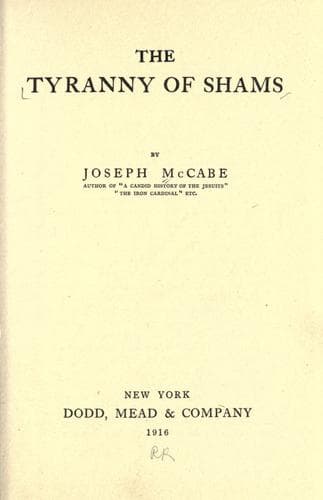
Great Britain -- Social conditions; Moral conditions; Social problems
There occur at once two methods of enrichment which invite careful
attention. One is the power to transmit wealth to one's descendants
in perpetuity, or until they choose to dissipate it. Most of us will
admit that in a social order at all resembling our own--and I do not
care to speculate about Utopian or imaginable orders--the power to win
advantages for one's children as well as for oneself is a sound
incentive to work. But the wish to relieve one's descendants of the
need to work, to make them for ever a burden on the community, is a
perverse ideal. It is one of those unsound primitive traditions which
we detect in the actual stream of our ideas and sentiments, and
instances are not unknown in our time of such holders of hereditary
wealth revolting against the tradition. When we realise that this
inherited wealth means, in plain terms, the right to have a hundred or
a thousand fellow-men working for us or our descendants in perpetuity,
for no merit or service on our part, and when we consider the folly
and waste which so commonly follow large inherited fortunes, we must
regard this tradition as evil and indefensible. One wonders how long
the working community is going to sustain this burden, and how long
refined men and women will imagine that they have a right to live like
Oriental potentates because they had a shrewd or a gifted ancestor.
It is sometimes said in their favour that they employ labour with
their wealth. I have heard bishops give them this foolish consolation.
As if the wealth would cease to exist, and to employ labour, if it
were in the pockets of a thousand men, instead of the pockets of one
Duke of Norfolk or Duke of Westminster! The only difference would be
that this wealth, instead of paying a thousand servants and
tradespeople to work for the comfort of one family, would pay a
thousand men, who would lose nothing by the change of employment, to
produce comfort for a thousand families. Meantime, the Duke is
embarrassed by his wealth, or spends it on superfluous things, and the
thousand families live in vicious misery. Their babies die for lack of
good milk in the hot summer, and the rich youth or maiden--I have
known this done--carelessly takes a bath of milk. Let us understand
clearly this economic truth: great wealth is the accumulation in one
man's hands of the right or power of a thousand families to employ
labour.
The second source of wealth which invites consideration is the
unearned increment on ground-values, or any other unearned and
accidental increase of value. It is now very commonly admitted that
this belongs to the community, and I need not enlarge on it.
Public-domain text, read in full here on John Shaqi.
Reviews
Reviews
No reviews yet
Be the first to share your thoughts on this work.
Elsewhere in the archive
Join the Discussion
Join the discussion
Sign in to leave a comment or review.
Sign InorCreate an account