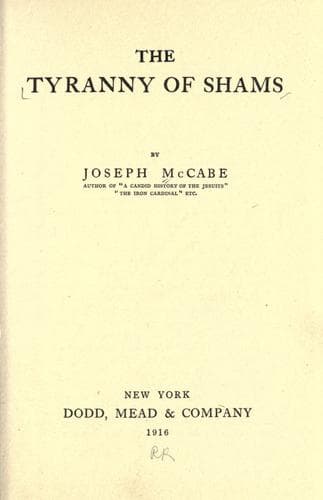
Great Britain -- Social conditions; Moral conditions; Social problems
This organisation of industry seems to be the only device which will
gradually restrict, and finally abolish, poverty. The opposition to it
of middle-class workers and of so many artisans is unintelligible. It
is time that we ceased to confine the term "workers" to the poorer
and less cultivated caste among those who work: time that the lawyer
and actor and housewife claimed that honourable title no less than the
carpenter or navvy. In restricting the term to manual and badly paid
workers we have concealed from ourselves the real community of
interest of all who work. All of us, except those who live on the
labour of others, have an interest in the proper organisation of the
work of the world and the removal from our shoulders of this
intolerable burden of the irregular workers and the idlers. The
middle-class has an even greater interest than what is narrowly called
the working-class, because the tendency of Labour-legislation is, and
will increasingly be, to put the heavier charge, not on large
employers, who easily evade it, but on the middle-class generally.
Here again the war has luminously illustrated our position. Both
employers and employed (in the current industrial sense) have made
great profit by it: the middle-class generally has suffered severely.
A proper organisation of work would have prevented this.
It can easily be shown that this national organisation of employment,
with graded incomes according to service rendered, is the only remedy
of poverty. The chief root of poverty is, as I said, the insufficiency
of properly paid work, and this is entirely due to the haphazard and
unsystematic nature of our industrial order. The private employer
looks only to the actual demand of commodities, or to the actual funds
for buying commodities. He has no interest in the moneyless
unemployed; indeed, he finds it a convenience to have a large number
from which he may select his workers. As a result, a large proportion
of our people are unable to demand their normal share of commodities
because they are not employed, or because they have no wage; and they
are not employed because they do not demand commodities. Plainly, the
community alone can alter this paradoxical state of things; and, since
the community is now compelled by its more humane sentiments to carry
the poor on its shoulders, it may at length be induced to see that it
would be better to set them on their own feet. In a properly organised
industrial system a worker will be paid by the commodities which he or
she actually produces, or their exchange-value. There can be no such
thing as a superfluous worker. It is only a lamentable issue of our
perverse pre-scientific system that millions must lack the food and
clothing and luxuries which they themselves could and would, under a
more orderly system, produce.
Public-domain text, read in full here on John Shaqi.
Reviews
Reviews
No reviews yet
Be the first to share your thoughts on this work.
Elsewhere in the archive
Join the Discussion
Join the discussion
Sign in to leave a comment or review.
Sign InorCreate an account