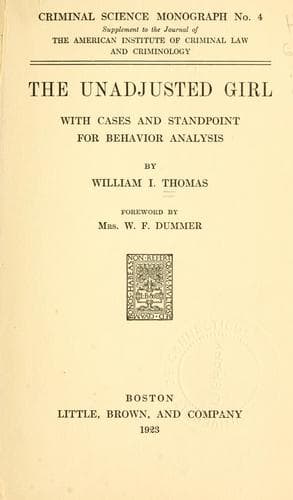
The Unadjusted Girl, With Cases and Standpoint for Behavior AnalysisThomas, William Isaac
Science
The Unadjusted Girl, With Cases and Standpoint for Behavior Analysis
Thomas, William Isaac
Female juvenile delinquents -- Case studies; Young women
The penitentiary and reformatory, to which offenders are condemned by
courts of law, have, as is well known, never been generally successful
in reorganizing the attitudes of their inmates on a social basis. They
represent the legal concept of crime and punishment and the theological
concept of sin and atonement. Where society is not able to organize the
wishes of one of its members in a social way it may exterminate him or
banish him to a society of the bad, which corresponds to the theological
purgatory from which there is a chance to return to a society of the
good. The punishment is supposed to atone for the offense and effect the
reformation.
The following case was handled by a particularly well equipped
reformatory for girls above the juvenile court age. Its staff at the
time was large and scientifically trained. It was probably more
completely equipped for the psychological study of its inmates than any
other institution whatever, and its records are more complete than any I
have seen elsewhere. But an institution dealing with a large number of
girls sentenced by the law courts, many of them hardened and rebellious,
has quite as much as it can do barely to maintain order. The situation
is the same as in the penitentiaries for men. The present case is not
typical; the girl is far from being as demoralized as the average girl
in the same institution. I cite it here to indicate what are the
attitudes of a girl in this situation, how accessible a girl may be to
influences and how unprepared an institution of this type is to employ
any organizing influences.
Esther had no previous bad record. She may or may not have had some sex
experiences; that is not unusual with girls of this class. It was not
shown that she was sexually diseased. Probably she was not but was
frightened into thinking so by a doctor who wanted $100.00. Her offense
was slight and casual. It might have been passed over with a reprimand,
or, as in the juvenile court, with a period of probation; but she was
nineteen—above the juvenile court age. The institution recognized, in
the statement given first below, that it would not be for her welfare to
hold her there, and placed her out on parole.
86. Statement from the Laboratory of Bedford Hills Reformatory for
Women:
Esther Lorenz was committed to the institution March 23, 1914, from
Special Sessions, N. Y.
Public-domain text, read in full here on John Shaqi.
Reviews
Reviews
No reviews yet
Be the first to share your thoughts on this work.
Elsewhere in the archive
Join the Discussion
Join the discussion
Sign in to leave a comment or review.
Sign InorCreate an account