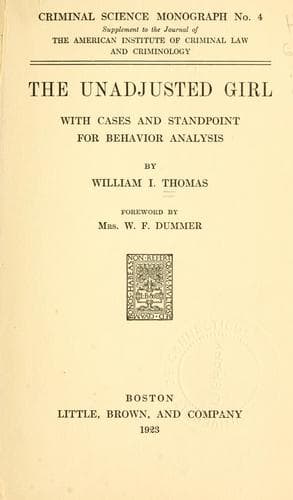
The Unadjusted Girl, With Cases and Standpoint for Behavior AnalysisThomas, William Isaac
Science
The Unadjusted Girl, With Cases and Standpoint for Behavior Analysis
Thomas, William Isaac
Female juvenile delinquents -- Case studies; Young women
88. Ruth, fourteen, Irish, pink-cheeked and blue-eyed, in her first year
of High School, the picture of attractive, innocent girlhood, had been
taken to the house of detention for stealing a diamond pin and taking
money from a teacher’s desk. When her denials were finally broken down
by proof, she confessed to a long history of petty thieving, hitherto
unpunished and for the most part undiscovered....
Ruth was an intensely egotistic person, desirous of social recognition,
approval, personal success; but due to lack of training, unfavorable
conditions and an impulsive, impatient make-up had never learned to work
for her satisfactions or make her impression on society in constructive
ways. She was quickly discouraged and resentful in the face of failure
or hardship and at once turned to some pleasure experience as a
compensation—something which could be obtained immediately and easily.
She used boastful stories and even her own misdeeds to heighten the
impression of her importance and superiority. This is a natural reaction
in childhood, where immediate gratification is obtained through crying,
tantrums, day dreams, purely subjective methods; but they are not
appropriate to a developing organism and must be abandoned for an
objective dealing with the facts of life. All of Ruth’s normal cravings
had been thwarted by her environment. She had lost her love object in
the death of her mother. Her family ideals had been shattered. Her
father had been exposed as unfaithful to her mother, and a weakling in
the battle between the stepmother and Ruth. He was a failure as a
provider and did not pay his debts. Ruth was forced to live in a home
situation which had for her none of the elements of a home, nothing to
be proud of, no loving approval and overlooking of faults, no faith, no
support and assurance of safety. She was forced not only to give up her
love object but to see it supplanted by an enemy, who also usurped her
place and influence with the father. Undoubtedly her sex ideals also met
with shock. She became convinced that her father was interested in
another woman before the death of the mother. Father and stepmother
quarreled and made up—separated and came together repeatedly. She saw
marriage as a series of endless petty conflicts. Both of them were
churchgoers, given to religious interests. Ruth’s disillusionment with
life was complete. There was nothing genuine, no real satisfaction. The
father and mother who constitute the bridges over which the emotional
life of the child may cross to a more and more social development had
blocked normal growth and thrown the child back upon subjective or
anti-social satisfactions. One of the defense reactions to such a
thwarting of fundamental needs is that taken by Ruth—a cynical,
suspicious, critical attitude toward everything and everybody. To want
and never get satisfaction is too painful a state to keep up, so the
individual criticizes every possible love object that he may make
Public-domain text, read in full here on John Shaqi.
Reviews
Reviews
No reviews yet
Be the first to share your thoughts on this work.
Elsewhere in the archive
Join the Discussion
Join the discussion
Sign in to leave a comment or review.
Sign InorCreate an account