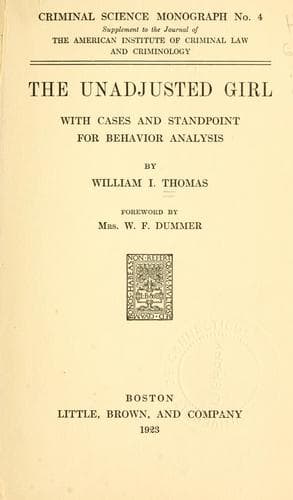
The Unadjusted Girl, With Cases and Standpoint for Behavior AnalysisThomas, William Isaac
Science
The Unadjusted Girl, With Cases and Standpoint for Behavior Analysis
Thomas, William Isaac
Female juvenile delinquents -- Case studies; Young women
[Arrangements should be made for] pooling the juvenile court’s probation
officers, the truancy department’s numerous officers, the school nurses,
the medical instructors, the special schools and reformatories, and all
the rest of the specialists on the physical, mental and social troubles
of school children into one department of adjustment.... Only the most
determined blindness could prevent [the school board member] from seeing
how the school truant officer and the probation officer overlap.... He
could surely see the waste of having the schools, on the one hand, build
up a staff of doctors and nurses and the juvenile court on the other
trying to duplicate this machinery—both sets to serve the same group of
children.[102]
These writers argue also that the juvenile court does not afford so good
an opportunity as the school for the study of the child and for
record-making, that the stigma placed on the child by an appearance in
court deprives him of the chance of future favorable recognition, that
the court cannot prevent delinquency, that the child is frequently
incorrigible before he reaches the court, that the courts have a very
limited range as propaganda and general educational agencies, since they
have no power over the child’s life before he comes actually before the
bar of justice, that the power of the probation officer is relatively
slight and casual, and that vocational placement should be connected
with the school.
Further than this, the depraved family conditions which I have
emphasized are due not only to bad economic conditions but to the
failure of community influence. You may have very good family life with
bad economic conditions but you cannot have good family life without
community influence. I have shown in Chapter II how strong was the
influence of the community on the family. It is not too much to say that
the community made the family good. Human nature often appears at its
worst in connection with pair marriages and small families. The records
of the societies for the prevention of cruelty to children are filled
with sickening details of the brutality of parents. An organic
connection with a larger community is necessary to the maintenance of
moral standards and fine sentiments. If we look, therefore, as we are
forced to look, for a social agency whose influence may penetrate the
family we find it in the school. The school is not a natural
organization like the family, but an artificial organization capable of
rapid changes and adjustments. In this respect it has almost the freedom
of a scientific laboratory. It receives all children early and keeps
them a relatively long time. Its function is the setting and solving of
problems and the communication of information. Its representatives are
far superior to the average parent in intelligence and understanding. If
we invented any device to replace social influence lacking at other
points it would be the school. It is probable that the school could be a
Public-domain text, read in full here on John Shaqi.
Reviews
Reviews
No reviews yet
Be the first to share your thoughts on this work.
Elsewhere in the archive
Join the Discussion
Join the discussion
Sign in to leave a comment or review.
Sign InorCreate an account