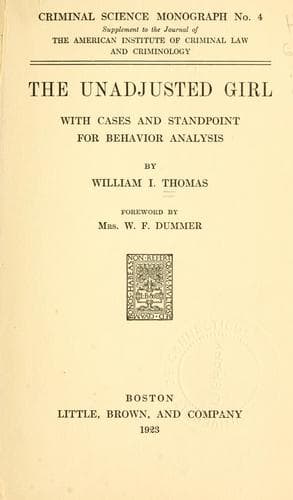
The Unadjusted Girl, With Cases and Standpoint for Behavior AnalysisThomas, William Isaac
Science
The Unadjusted Girl, With Cases and Standpoint for Behavior Analysis
Thomas, William Isaac
Female juvenile delinquents -- Case studies; Young women
This emotional prepossession for habitual ways of doing things enters
into and controls social investigations, particularly social reforms.
The Vice Commission of Chicago, for example, which undertook an
investigation of prostitution, was composed of thirty representative
men, including ministers, physicians, social workers, criminologists,
business men and university professors. In the introduction to its
report it was at pains to state that it was anxious to make no
discoveries and no recommendations which did not conform to standards
accepted by society. “[The Commission] has kept constantly in mind that
to offer a contribution of any value such an offering must be, first,
moral; second, reasonable and practical; third, possible under the
constitutional powers of our courts; fourth, that which will square with
the public conscience of the American people.” This commission made, in
fact, a very valuable report. It even included items of scientific value
concerning prostitution which led the federal authorities to exclude the
report from the mails (the decision was later reversed) but it had
determined beforehand the limitations and character of its investigation
and results, and excluded the possibility of a new determination of
behavior norms in this field.
A method of investigation which seeks to justify and enforce any given
norm of behavior ignores the fact that a social evolution is going on in
which not only activities are changing but the norms which regulate the
activities are also changing. Traditions and customs, definitions of the
situation, morality, and religion are undergoing an evolution, and a
society going on the assumption that a certain norm is valid and that
whatever does not comply with it is abnormal finds itself helpless when
it realizes that this norm has lost social significance and some other
norm has appeared in its place. Thus fifty years ago we recognized,
roughly speaking, two types of women, the one completely good and the
other completely bad,—what we now call the old-fashioned girl and the
girl who had sinned and been outlawed. At present we have several
intermediate types,—the occasional prostitute, the charity girl, the
demi-virgin, the equivocal flapper, and in addition girls with new but
social behavior norms who have adapted themselves to all kinds of work.
And some of this work is surprisingly efficient. Girls of twenty and
thereabouts are successfully competing in literature with the veteran
writers. But no one of these girls, neither the orderly nor the
disorderly, is conforming with the behavior norms of her grandmother.
All of them represent the same movement, which is a desire to realize
their wishes under the changing social conditions. The movement contains
disorganization and reorganization, but it is the same movement in both
cases. It is the release of important social energies which could not
find expression under the norms of the past. Any general movement away
Public-domain text, read in full here on John Shaqi.
Reviews
Reviews
No reviews yet
Be the first to share your thoughts on this work.
Elsewhere in the archive
Join the Discussion
Join the discussion
Sign in to leave a comment or review.
Sign InorCreate an account